Why Many Researchers Today Use the Term “Indus-Saraswati Civilization”
Introduction
Ask someone about the world’s oldest civilizations, and they are likely to mention Egypt, Mesopotamia, or the Indus Valley Civilization. For nearly a century, this has been the most familiar name for the Bronze Age urban culture that flourished across northwestern South Asia.
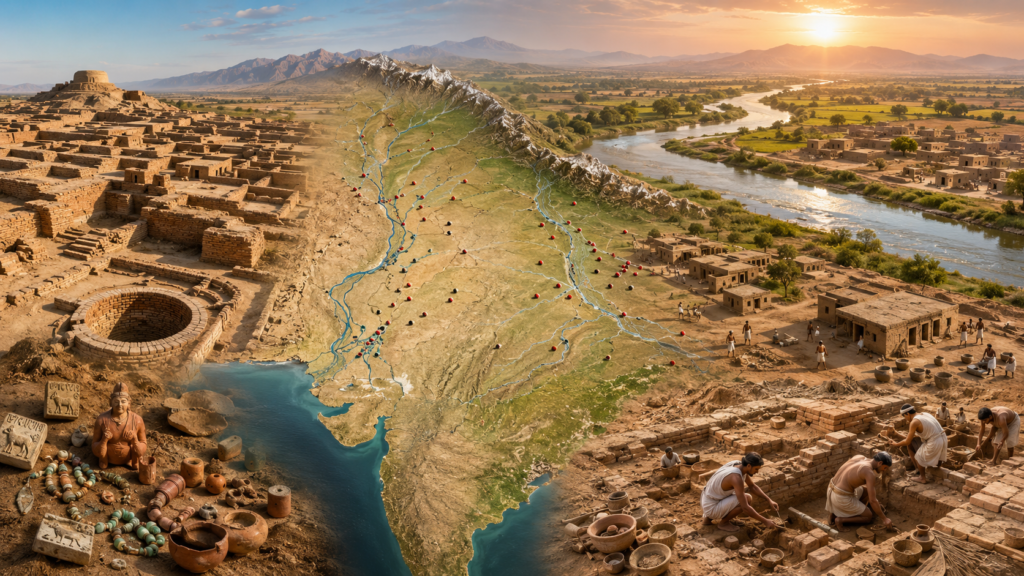
However, over the past several decades, archaeological discoveries have dramatically expanded our understanding of this civilization. Excavations have revealed hundreds of settlements extending far beyond the Indus River basin, especially across present-day Haryana, Rajasthan, Gujarat, and Cholistan. Many of these sites lie close to the dry channels of the Ghaggar-Hakra river system, which some researchers associate with the Saraswati described in ancient Indian literature.
As a result, many archaeologists and historians now use the broader term Indus-Saraswati Civilization. Others continue to prefer Indus Civilization or Harappan Civilization. Understanding why these different terms are used is essential for appreciating both the archaeological evidence and the ongoing scholarly discussion.
Why Was It Originally Called the Indus Valley Civilization?
The story begins in the early twentieth century.
The spectacular discoveries at Harappa (now in Pakistan) and Mohenjo-daro transformed the study of ancient India. These were the first major urban settlements of this civilization to be excavated, and both were located within the Indus River basin.
Based on the evidence available at the time, archaeologists naturally named it the Indus Valley Civilization.
This was not unusual. Ancient civilizations have often been named after the rivers along which they were first discovered:
- Nile Civilization
- Tigris-Euphrates Civilization
- Yellow River Civilization
The name reflected the geographical knowledge available during the 1920s rather than the complete extent of the civilization.
Archaeology Changed the Picture
As archaeological work expanded after Independence, researchers began discovering settlements across a much wider region.
Today, thousands of archaeological sites associated with the Harappan cultural tradition have been identified across:
- Pakistan
- Haryana
- Punjab
- Rajasthan
- Gujarat
- Jammu
- Western Uttar Pradesh
Many of the largest and oldest settlements are located outside the Indus Valley itself.
Some notable examples include:
Site | Present Location |
Rakhigarhi | Haryana |
Bhirrana | Haryana |
Kalibangan | Rajasthan |
Banawali | Haryana |
Farmana | Haryana |
Dholavira | Gujarat |
Lothal | Gujarat |
These discoveries significantly expanded the known geographical footprint of the civilization.
The Saraswati River in Ancient Literature
Ancient Indian texts, particularly the Rigveda, describe a mighty river named Saraswati.
It is portrayed as an important river associated with settlements, rituals, and cultural life. Later texts also refer to changes in its course and eventual disappearance.
For centuries, historians debated whether this river represented:
- a historical river,
- a symbolic river,
- or a combination of both.
This question remains an active area of research.
The Ghaggar-Hakra River System
One of the most discussed topics in South Asian archaeology is the Ghaggar-Hakra river system.
Satellite imagery, sediment studies, geomorphology, and archaeological surveys have identified extensive ancient river channels running through parts of Haryana, Rajasthan, and Cholistan.
Many Harappan settlements are found along or near these paleochannels.
Because of this distribution, some researchers have proposed that sections of the Ghaggar-Hakra system may correspond to the river remembered as Saraswati in ancient literature.
Other researchers interpret the geological and chronological evidence differently and do not consider the identification established.
This remains an area of ongoing scientific investigation.
Why Many Scholars Prefer “Indus-Saraswati Civilization”
The broader term Indus-Saraswati Civilization is used by many researchers because it reflects the civilization’s wider geographical distribution rather than restricting it to the Indus Valley alone.
The reasoning includes:
- Numerous settlements lie outside the Indus basin.
- Major urban centres flourished in the Ghaggar-Hakra region.
- Archaeological evidence demonstrates a civilization extending across an enormous landscape.
- The combined term acknowledges both the Indus basin and the eastern settlement network.
At the same time, many scholars continue to use Harappan Civilization, a neutral archaeological term derived from the type site of Harappa.
Consequently, all three names—Indus Civilization, Indus Valley Civilization, and Harappan Civilization—remain common in academic literature, while Indus-Saraswati Civilization is used by many researchers to emphasize the broader geographical context.
Does This Change History?
The discoveries do not change the existence of the civilization—they deepen our understanding of it.
Archaeology now presents a picture of a civilization that occupied a vast area of approximately one million square kilometres, making it one of the largest Bronze Age civilizations in the world.
New excavations continue to refine knowledge about:
- settlement patterns,
- agriculture,
- trade,
- urban planning,
- water management,
- metallurgy,
- craft production,
- and regional diversity.
As new evidence emerges, historians naturally revisit earlier interpretations.
That is how archaeology advances.
Why the Debate Matters
The discussion is not merely about changing a name.
It concerns how accurately a name reflects the geographical extent of one of humanity’s earliest urban civilizations.
The evidence clearly shows that important centres existed well beyond the Indus River basin. Questions about the identification of ancient river systems, including the relationship between the Ghaggar-Hakra channels and the Saraswati described in early texts, continue to be investigated through archaeology, geology, hydrology, and related sciences.
Understanding this distinction helps readers appreciate both the established archaeological record and the areas where research is still evolving.
Frequently Asked Questions
Is the Saraswati Civilization different from the Indus Civilization?
The term Saraswati Civilization is used by some writers to emphasize settlements associated with the Ghaggar-Hakra region. In academic literature, the most common terms remain Indus Civilization, Harappan Civilization, and increasingly Indus-Saraswati Civilization among some researchers.
Why is it also called the Harappan Civilization?
Because Harappa was the first major site excavated and serves as the type site for the archaeological culture.
Is the Saraswati River mentioned in ancient Indian texts?
Yes. The Rigveda contains several references to the Saraswati. How those references relate to specific ancient river systems remains a subject of ongoing scholarly research.
Why has the terminology changed?
The discovery of many archaeological sites outside the Indus Valley encouraged some researchers to adopt terminology that better reflects the civilization’s wider geographical distribution.
Conclusion
The story of the Indus or Harappan Civilization continues to evolve as archaeology uncovers new evidence. While the civilization was originally named after discoveries in the Indus Valley, subsequent excavations revealed an extensive network of settlements across northwestern South Asia.
For this reason, many researchers now use the term Indus-Saraswati Civilization to describe its broader geographical spread, while others continue to use the traditional names. Rather than viewing these terms as competing histories, readers should understand them as different ways of describing the same archaeological tradition, informed by expanding evidence and ongoing research.
The continuing study of sites such as Rakhigarhi, Bhirrana, Kalibangan, and Dholavira reminds us that history is not static. Each new excavation has the potential to refine our understanding of one of the world’s earliest and most remarkable civilizations.
Website Links