
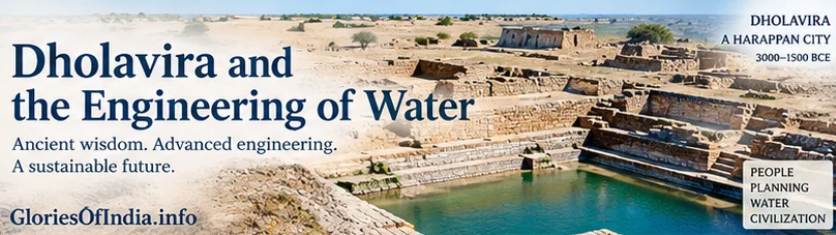
Dholavira and the Engineering of Water: What the Archaeology Actually Shows

Archaeological reservoirs and urban remains at Dholavira showing Harappan water management engineeringDholavira and the Engineering of Water: What the Archaeology Actually Shows

Glories of India Research Programme  •  Archaeology & Harappan Civilization

Ancient technological achievement is most convincing when we do not need exaggeration.
Dholavira is an excellent example.
Located on Khadir Island in present-day Gujarat, the Harappan city developed in an environment where reliable water was a fundamental challenge. The archaeological response to that challenge survives in reservoirs, channels, drains and the organisation of the settlement itself.

UNESCO, which inscribed Dholavira on the World Heritage List in 2021, describes its sophisticated water-management system and planned urbanism as defining technological achievements.

Why Dholavira Matters

Dholavira was occupied for roughly fifteen centuries, with UNESCO placing its occupation approximately between 3000 and 1500 BCE. Its remains include a fortified city, residential areas, workshops, a ceremonial ground, cemetery and substantial water-management infrastructure.
Its importance therefore lies not in a single spectacular artefact.
It lies in the organisation of an entire urban system.

Building a City Where Water Was Scarce

Unlike settlements benefiting from a major perennial river, Dholavira occupied an arid landscape.
Two seasonal streams were available, but seasonal water creates an engineering problem: water arriving at one time of year must be captured, directed, stored and managed for later use.
The inhabitants responded by integrating water management into the city.

UNESCO records a series of reservoirs to the east and south of the citadel and identifies technological advances in water harnessing and drainage as central features of the site.
This is significant because successful water storage requires more than digging a large pit. Builders need practical knowledge of terrain, runoff, gradients, construction, storage capacity and maintenance.

Reservoirs, Drains and Urban Planning

The archaeological significance of Dholavira emerges from the relationship between its systems.
Water management was connected with city planning.
Urban sectors, fortifications, streets, reservoirs and drainage were not isolated constructions accumulated randomly over time. UNESCO characterises Dholavira as an outstanding example of Harappan urban planning, including preconceived city planning, multi-layered fortifications, sophisticated reservoirs and drainage.
This suggests administrative capacity as well as engineering ability. Large public works require labour organisation, planning and the transmission of practical knowledge.

What Engineering Knowledge Was Required?

Archaeology cannot provide the lost engineering manual of Dholavira. But structures reveal capabilities.
To create functioning reservoirs and drains, builders had to work successfully with:

  • elevation and gradient,
  • seasonal water movement,
  • storage,
  • local building materials,
  • structural stability,
  • urban drainage,
  • and repeated maintenance.

This is an important methodological point. Ancient technological knowledge was not always preserved in texts.
Sometimes the object itself is the surviving document.

What the Evidence Does Not Prove

Dholavira should also teach caution.
Its sophisticated infrastructure does not establish every modern claim made about ancient Indian technology.
Archaeology permits strong conclusions where physical evidence exists and weaker conclusions where it does not.
That distinction strengthens rather than diminishes India’s scientific heritage.
We do not need to describe Dholavira as possessing mysterious or impossibly advanced technology. Its documented achievement is impressive enough.

Dholavira and the Wider Harappan World

Dholavira was not isolated.

UNESCO notes evidence of manufacturing and inter-regional trade, including connections with other Harappan centres and regions associated with Mesopotamia and the Oman peninsula.
The wider Harappan world also demonstrates standardized construction, craft specialization and extensive settlement networks.
What systems of knowledge allowed complex urban communities to operate across such a large geographical region?

Why This Changes the Question We Ask

Older popular histories often present ancient civilizations primarily through rulers, wars and monuments.
Dholavira suggests another way to examine civilization.
Look at infrastructure. Look at water. Look at adaptation. Look at the knowledge embedded in ordinary survival.
A civilization’s intellectual history does not exist only in manuscripts.
Civilization is not only written in texts. Sometimes it is carved into reservoirs.
At Dholavira, water engineering gives us an unusually durable record of practical intelligence in the Harappan world.


Key Takeaways

  • Dholavira was a major planned Harappan urban settlement.
  • Water scarcity was addressed through sophisticated harvesting, storage and drainage infrastructure.
  • UNESCO specifically identifies its water-management system as a major technological achievement.
  • Archaeological structures demonstrate practical engineering knowledge even where technical manuals have not survived.
  • Dholavira’s documented achievements are substantial without speculative embellishment.

Frequently Asked Questions

What makes Dholavira’s water system important?

It demonstrates sophisticated adaptation to an arid environment through planned water harvesting, storage and drainage integrated with the city.

When was Dholavira occupied?

UNESCO places its occupation broadly between about 3000 and 1500 BCE.

Was Dholavira an isolated city?

No. Archaeological evidence cited by UNESCO indicates inter-regional trade with other Harappan cities and regions associated with Mesopotamia and the Oman peninsula.

From Evidence to the Larger Civilizational Story

Explore Indian Civilization Reborn for the wider investigation of how archaeology, environment, technology and knowledge systems reshape our understanding of ancient Bharat. Readers interested in how historical narratives are constructed can begin with Stop Teaching Rotten History.

Explore the books →

Authoritative Reference

UNESCO World Heritage Centre — Dholavira: a Harappan City

Leave a Comment

Your email address will not be published. Required fields are marked *

DID JESUS COME TO INDIA

For nearly two millennia, the Church has been silent about Jesus’s life between age 13 and 30. But what if he didn’t disappear—what if he journeyed east to India? Historical evidence, ancient Buddhist scrolls from Hemis Monastery, and a mysterious tomb in Srinagar suggest that Jesus lived among Indian sages, studied Vedas, embraced nonviolence, and preached love in the very land of Sanatan Dharma.

During my personal visit to Rozabal Shrine and talks with Dr. Fida Hassnain, the truth became clearer: this was not myth, but buried reality. Even the Abbot at Hemis offered a guarded silence—revealing more than words.

This truth shatters colonial narratives and unites spiritual traditions. Was India the real shaping ground for Christ’s divine wisdom? The West may have hidden this—but now, it’s time to uncover it.


This will close in 300 seconds

Jesus’ Journey Across India

For centuries, the world has debated whether Jesus ever stepped outside the Holy Land. But few have dared to follow the faint yet powerful trail that leads deep into the heart of India. Between the ages of 13 and 30, the Bible is silent — but India speaks. Through my personal travels, conversations with monks and historians, and decades of cross-cultural research, I have come to believe that Jesus not only visited India but evolved here into the spiritual master known as Christ.


This will close in 300 seconds

The Hidden Journey – Where Jesus Walked Across India

Did Jesus vanish—or did he walk across India? Ancient Buddhist scrolls, Rozabal Shrine, and a hand-drawn route by Dr. Fida Hassnain suggest he studied Vedas, preached compassion, and meditated across Bharat. I, Dinesh Rawat, walked that same path—from Ladakh to Kanyakumari and across to Sri Lanka. The silence of Hemis monks and the legacy in Kerala speak louder than scripture. India may have shaped the light the West calls Christ.


This will close in 300 seconds

REBIRTH ERASED FROM CHRISTIANITY

For the first 500 years of Christianity, reincarnation was not a heresy—it was part of the belief system. Early Church fathers like Origen taught that the soul is eternal and takes multiple births to evolve spiritually. But this powerful truth was suppressed in 553 CE during the Second Council of Constantinople. Emperor Justinian, influenced by his wife Theodora, passed a decree banning belief in reincarnation. This political act reshaped Christianity. Today, millions are unaware that Jesus may have spoken of rebirth in subtle ways. From my personal research and visits to ancient Christian and Indian sites, I present evidence that the idea of rebirth once had a place in Christian theology. The deletion of reincarnation wasn’t spiritual—it was strategic. Rediscovering it revives our shared spiritual heritage and brings Christianity closer to Sanatan Dharma.


This will close in 300 seconds

JESUS' TOMB IN SRI NAGAR

In 2011, I traveled to Srinagar in search of a truth the world has long ignored — that Jesus, known locally as Yuz Asaf, may have spent his final days in India. At Rozabal Shrine, a humble tomb in Khanyar, I experienced a profound spiritual realization. Locals reverently believe this is the resting place of Jesus. My encounter with historian Dr. Fida Hassnain confirmed this belief through ancient texts and global evidence. He shared how church authorities and Western historians have silenced this truth to protect dogma. I personally witnessed the carved footprints inside the tomb — a distinct Indian tradition — and felt a powerful, inexplicable energy. Rozabal is not just a tomb; it is a spiritual beacon. I didn’t just read history—I lived it. This is my soul’s testimony: Jesus came to India, walked among its saints, and now rests in the land that embraced him.


This will close in 300 seconds

Echoes of the East in the Holy Scripture

What if India was always part of the Biblical world—but hidden in plain sight? This blog explores forgotten mentions and subtle references to India in the Bible. From ancient trade with Ophir (possibly India) to the gifts brought by the Magi (frankincense and myrrh sourced from the East), echoes of Bharat resonate throughout the scripture. India’s spices, gemstones, and wisdom were known to the Hebrews. The apostles traveled eastward, and traditions say Thomas reached Kerala. These aren’t coincidences—they’re clues. This exploration connects ancient Indian influence with Biblical history, challenging Eurocentric narratives. It invites readers to rediscover India’s spiritual presence in global religious texts. This isn’t just about geography—it’s about restoring India to its rightful place in the divine conversation of humanity.


This will close in 300 seconds

ADVANCED INDIA 9500 YEARS AGO

India’s Forgotten Cradle of Civilization – Why Bhirrana, Rakhigarhi, and Kalibangan Are Older Than Mesopotamia and Egypt

History textbooks tell us that Mesopotamia and Egypt were the cradles of civilization. But modern archaeology says otherwise…


This will close in 300 seconds

BHARAT: MOTHER OF EDUCATION & DISCOVERY

In a world driven by deadlines, digital time, and modern calendars, have we forgotten the eternal clock that beats beyond seconds and hours? India, the land of timeless wisdom, never saw time as a line — it saw time as a cycle. A rhythm. A breath of the cosmos.


This will close in 300 seconds

Cities Without Temples, Without Crime, Without Writing

The Harappan civilization offers a quiet revolution in urban philosophy. Cities like Rakhigarhi, Bhirrana, Kalibangan, and Dholavira defy conventional models — they had no central temples, no military dominance, no written law, yet flourished in harmony. Rakhigarhi showcases advanced planning without spiritual hierarchies. Bhirrana, possibly India’s oldest city, reveals a peaceful, nature-aligned lifestyle. Kalibangan’s fire altars and ploughed fields indicate agrarian spirituality. Dholavira’s water engineering reflects intelligence over conquest. Across these cities, standardized systems and peaceful coexistence hint at a dharmic rhythm, where values governed from within. This forgotten legacy reimagines civilization not as power, but as presence — spirituality embedded in action, not architecture.


This will close in 300 seconds

ANCIENT INDIA’S SKY SCIENCE

Vimana Shastra presents an enigmatic vision of ancient Indian aerial technology, blending mythology, symbolism, and cosmic philosophy. Believed to be channeled in 1918 by Subbaraya Shastry, the text claims origins in Maharshi Bharadwaja’s wisdom. It describes vimanas powered by solar energy and mercury, detailed with alloys, crystals, routes, and even pilot diets. While modern science questions its technical feasibility, its metaphorical richness endures. In epics like Ramayana and Mahabharata, vimanas reflect spiritual ascension rather than mechanical flight. Comparative myths across Egypt, Greece, and Mesoamerica echo similar dreams of sky travel. Ultimately, Vimana Shastra serves not as an instruction manual, but as a poetic blueprint of consciousness, reminding us that India’s ancestors dared to dream beyond the tangible — merging dharma, design, and the divine into airborne allegory.


This will close in 300 seconds

Indians Knew the Earth Was Round Long Before the Greeks

Ancient Indian thinkers understood Earth’s spherical nature long before Greek philosophers. Terms like Bhugola—”sphere of Earth”—and detailed astronomical models in texts like the Surya Siddhanta showcase remarkable scientific insight. Aryabhata proposed Earth’s rotation in 499 CE, challenging flat-Earth views with a dynamic cosmological explanation. Later, Brahmagupta accurately calculated planetary motions and the solar year’s length. These revelations weren’t borrowed—they were part of India’s intellectual legacy, embedded in temple architecture, ritual design, and cosmic philosophy. Vedic hymns and Puranic verses often depicted the Earth as suspended in space, revealing an integration of observation and symbolism. Indian cosmology merged science with metaphysical inquiry, suggesting that the pursuit of truth was both rational and spiritual. A spherical Earth was not just geometry—it was Prakriti, a living symbol of cosmic order.


This will close in 300 seconds

Ayurveda and Yoga – India’s Timeless Gifts to the World

Ayurveda and Yoga are India’s sacred contributions to global wellness. More than just healing systems, they represent a holistic vision of life rooted in Sanatan Dharma. Ayurveda, the “Science of Life,” balances the body’s elements—Vata, Pitta, and Kapha—through nature, herbs, and lifestyle. Yoga, meaning “to unite,” connects the body, mind, and soul through discipline, breath, and meditation. Both traditions offer inner harmony, spiritual awakening, and lasting well-being. In today’s chaotic world, people across the globe are embracing these ancient Indian paths as modern solutions. While the West hails them as new trends, they were born in the lap of Bharat’s rishis thousands of years ago. It is time for Indians to remember and re-honor this legacy that the world now admires. These are not alternatives—they are eternal truths.


This will close in 300 seconds

India – The Source Civilization Evident from Global Migration Patterns

India is not just an ancient land—it is the source of global civilization. Genetic research has debunked the Aryan Invasion Theory, proving continuity in Indian populations for over 10,000 years. Sites like Bhirrana and Rakhigarhi are older than Mesopotamian cities. Sanskrit’s deep influence on European and Asian languages shows linguistic migration out of India. Vedic rituals, deities, and symbols like the Swastika are found across continents. From Angkor Wat to Stonehenge, spiritual architecture reflects Vedic cosmic principles. Indigenous tribes globally share concepts like karma, reincarnation, and sun worship—clear echoes of Vedic thought. India’s civilization expanded not through war but through wisdom. It is time India reclaims her place as the Adi-Sanskriti—The Source Civilization that inspired the world.


This will close in 300 seconds

Aryan Invasion Theory – A Fiction?

The Aryan Invasion Theory (AIT) was not a historical discovery—it was a colonial conspiracy to divide Indians, justify British rule, and destroy national pride. It falsely claimed that a Central Asian Aryan race invaded India around 1500 BCE, bringing Vedas and civilization. But modern DNA studies and archaeology reveal there was no such invasion. Sites like Rakhigarhi show genetic continuity for over 10,000 years. Sanskrit, Vedic rituals, and spiritual traditions were born in India, not imported. AIT created a false North-South divide and continues to impact politics and education. The truth is: India is the Adi-Sanskriti—a continuous, indigenous civilization. It is time to erase this lie from our books and minds. We are not invaders—we are the inheritors of Sanatan Dharma.


This will close in 300 seconds

Why British Historians Lied About India's Glorious Past

British historians rewrote Indian history to serve their empire. By calling India a land of superstition and stagnation, they justified colonization and destroyed civilizational pride. They invented theories like the Aryan Invasion, distorted timelines to show India as younger than Greece, and divided Indians by race, caste, and region. Science now proves them wrong—genetics shows 10,000 years of Indian continuity, Sanskrit predates Latin, and ancient cities like Bhirrana are older than Mesopotamia. But colonial lies still rule our textbooks. The goal was clear: to enslave not just bodies, but minds. Today, reclaiming our true history is not just a cultural task—it is a spiritual revolution. We must break free from mental colonization and proudly declare: India is the Adi-Sanskriti, the original civilization.


This will close in 300 seconds

How India’s Ancient Temples Were Rebranded as Mosques and Tombs

Many grand Islamic monuments in India may actually be ancient Hindu temples taken over and renamed. From Qutub Minar to Gyanvapi, numerous sites reveal signs of earlier temple structures—pillars, sanctums, and Sanskrit inscriptions—hidden under later Islamic additions. These weren’t newly built structures, but cleverly rebranded ones. British historians, trusting Persian chronicles, accepted these false claims without archaeological proof. This distorted version of history was institutionalized in our textbooks. The truth? These buildings are echoes of India’s glorious Sanatan past, forcibly altered to suit foreign narratives. Reclaiming this truth is not about religion—it’s about civilizational pride and correcting historical injustice. As independent researchers and eyewitness travelers uncover more evidence, a new India must rise to restore its lost legacy.


This will close in 300 seconds

The Architects of Deception – Who Twisted Indian History and Why

It wasn’t a mistake—it was a deliberate colonial conspiracy. From James Mill’s biased historical framework to Macaulay’s mind-shaping education system, from Max Müller’s manipulations of Vedic timelines to Cunningham’s false labeling of Hindu monuments—each step was planned. Institutions like ASI and ICHR further cemented these lies, while Leftist historians later continued the distortion. Brave voices like P.N. Oak, R.C. Majumdar, and Sitaram Goel were suppressed. The aim? To break India’s pride, unity, and spiritual backbone. But truth is rising again. And it’s time to name the deceivers, reclaim our roots, and restore the real Indian story.


This will close in 300 seconds

India Under Siege – The Invisible War Within and Beyond

Even in 2025, India faces grave threats — both from foreign forces and internal enemies. Western powers like the USA manipulate media and fund NGOs to distort India’s image. China intrudes on borders, engages in cyber warfare, and uses economic traps. Pakistan continues exporting terror. Bangladesh poses a silent threat via illegal immigration and demographic shifts. Internally, India battles religious conversions, intellectual subversion, digital manipulation, and vote bank politics. This is not just a political or military conflict — it’s a civilizational war to weaken Bharat’s roots. India must awaken, reclaim cultural pride, strengthen national security, and break mental slavery to become truly free.


This will close in 300 seconds

The Conversion War – From Ghazni to Changur Baba: How India’s Soul Was Targeted for Centuries

India has faced over a thousand years of a silent but deadly war – the war of religious conversion. From Mahmud of Ghazni’s violent invasions to British missionary tactics and modern NGO manipulation, the strategy has remained the same: break India’s spiritual foundation, replace Sanatan Dharma with foreign doctrines, and mentally colonize the population. Dinesh Rawat’s book The Conversion War – From Ghazni to Changur Baba exposes how India’s temples, saints, and poor have been systematically targeted through force, deceit, and economic lures. The story of Changur Baba highlights how even revered Indian saints are misused posthumously for mass conversion. Today, with digital platforms, this war has entered our homes. This is not freedom of faith—it’s cultural aggression. The book calls for awareness, legal vigilance, and revival of Dharmic pride. It is a wake-up call to protect India’s soul before it’s too late.


This will close in 300 seconds

The World Keeps Vedic Time – The Forgotten Global Legacy of Bharat

Did you know the global time system — seconds, minutes, hours, weekdays, and even months — has deep Vedic roots? From the Sanskrit word Samay (time) to Hora (hour), from Ghati (24 minutes) to Sankalpa (cosmic calculation before Vedic rituals), India gifted the world its original timekeeping science. Even “Christmas” derives from “Krishn-mas”, as Lord Krishna declared December (Margashirsha) his month. The week’s days, from Sunday to Saturday, follow the Vedic planetary order. Western months like September to December still carry Sanskrit names: Saptambar, Ashtambar, Navambar, Dashambar. The British Empire, Rome, and even early Christian customs mirrored Vedic tradition until colonial and religious distortions replaced them. This truth has been hidden — but it’s time we reclaim it. The world still follows Vedic time — unknowingly. Let us restore that conscious pride in India’s ancient scientific glory.


This will close in 300 seconds

Who Really Wrote Our History Textbooks? – Unmasking the Ghostwriters of Indian History

For centuries, Indians have studied a version of history written not by our ancestors, but by colonizers and their ideological heirs. From James Mill and Thomas Macaulay to modern Marxist historians, the Indian narrative was rewritten to glorify invaders, diminish ancient achievements, and erase spiritual wisdom. Our textbooks taught us to begin Indian history with foreign rule—neglecting millennia of science, democracy, temple architecture, and Vedic knowledge. After Independence, Nehru-era historians carried forward the colonial legacy, suppressing regional heroes and spiritual science in favor of secular ideology. Today, discoveries at sites like Rakhigarhi and Dwarka, and voices of researchers like P.N. Oak and Dr. Fida Hassnain are restoring India’s truth. It’s time to reclaim our story, rewrite our textbooks, and raise a generation proud of their civilization.


This will close in 300 seconds

The Ancient Sanskrit Atlas – How the Whole World Spoke the Language of the Vedas

What if the names of countries, cities, rivers, and oceans across the world were originally Sanskrit? The Ancient Sanskrit Atlas uncovers a forgotten truth — that the Vedic civilization and its sacred language, Sanskrit, once had a global footprint. From Australia (Astralaya) and America (Amareesh) to Russia (Rusheeya) and the Nile (Neel Saraswati), place names reveal striking Sanskrit origins. The Himalayas’ ‘little brother’ became the Alps, while the mighty Danube echoes the Danavas of Vedic lore. These are not coincidences, but clues that ancient India was the spiritual and cultural heart of humanity. Let us rediscover this truth and reclaim India’s rightful place in world history.


This will close in 300 seconds

India: The Wealthiest Civilization the World Ever Knew – Until 200 Years Ago

For nearly 2000 years, India was the wealthiest civilization on Earth. From 1 CE to 1700 CE, its share in global GDP consistently remained above 20–30%. India led the world in textiles, gems, spices, metallurgy, and intellectual knowledge. Cities like Pataliputra, Varanasi, and Murshidabad were global trade hubs, while temples functioned as banks and welfare centers. But after British colonization began in 1757, India’s economy was systematically dismantled. By 1947, its global GDP share had dropped to just 3.8%. This wasn’t decline—it was loot. Over $45 trillion was extracted by the British. Yet, India’s spiritual and civilizational strength endured. It is time to reclaim our forgotten legacy and tell the world that India was never a third-world nation—it was the first-world civilization.


This will close in 300 seconds

Why Do Indian History Books Start with Invaders – Unmasking the Colonial Blueprint

For nearly 2000 years, India was the wealthiest civilization on Earth. From 1 CE to 1700 CE, its share in global GDP consistently remained above 20–30%. India led the world in textiles, gems, spices, metallurgy, and intellectual knowledge. Cities like Pataliputra, Varanasi, and Murshidabad were global trade hubs, while temples functioned as banks and welfare centers. But after British colonization began in 1757, India’s economy was systematically dismantled. By 1947, its global GDP share had dropped to just 3.8%. This wasn’t decline—it was loot. Over $45 trillion was extracted by the British. Yet, India’s spiritual and civilizational strength endured. It is time to reclaim our forgotten legacy and tell the world that India was never a third-world nation—it was the first-world civilization.


This will close in 300 seconds

India: The World’s Oldest University System – A Civilization That Educated the World

India became free in 1947—but only politically. The British flag was lowered, yet British systems, mindsets, and frameworks stayed. Macaulay’s education, Mill’s distorted history, colonial laws, Nehru’s Western admiration, and temple control—everything remained. The result? A free nation trapped in foreign thought. Even our historians, judges, and journalists continued the colonial echo. True freedom is not just about governance—it’s about reclaiming our civilization, culture, and confidence. And that freedom is still incomplete. We must now break mental slavery and reawaken Bharat’s eternal soul.


This will close in 300 seconds

Bharat Before History Began – Discoveries Through My 35-Year Journey

In my travels to 60 countries over 35 years, I explored pyramids, temples, and ruins. Yet, the truth struck me strongest in Bharat.

At Bhirrana, I stood on the oldest settlement (7500 BCE). At Kalibangan, I saw ploughed fields. In Mehrgarh, I found proof of 9000-year-old dentistry. Dholavira’s water systems amazed me, and Rakhigarhi DNA confirmed Harappans as our ancestors.

Having seen Mesopotamian and Egyptian relics too, I know: India is the world’s oldest continuous civilization—10,000 years strong.


This will close in 300 seconds

Mehrgarh: The First Village of the World – My Journey of Discovery

In my travels to 60 countries over 35 years, I never found anything as profound as Mehrgarh. Dating back to 7000 BCE, it is the world’s first organized village.

Here, humans grew wheat and barley, practiced crop rotation, stored grains, worked with copper, and even performed dental surgery.

Mehrgarh proves what I saw across the globe—civilization did not begin in Mesopotamia. It began in Bharat.


This will close in 300 seconds

Bhirrana: Standing on the World’s Oldest Harappan Site – My Journey of Truth

Bhirrana: The First Heartbeat of Civilization

During my 35 years of travels across 60 countries, I discovered that the world’s oldest settlement is not in Mesopotamia but in Bhirrana, Haryana.

Dating back to 7500 BCE, it reveals farming, pottery, fire altars, and city planning. I saw with my own eyes that India’s continuity stretches unbroken from Harappans to today.

Bhirrana proves: Bharat is the cradle of civilization.


This will close in 300 seconds

Kalibangan: Where Farming and Faith Began – My On-Ground Discovery

Kalibangan: Where Farming Met Faith

In my 35 years of travels across 60 countries, Kalibangan stood out.

Here, archaeologists found the world’s first ploughed fields (2800 BCE) and fire altars linked to Vedic rituals. I stood on that soil and felt the truth—Harappan and Vedic traditions are one.

Kalibangan proves that Bharat gave the world its first farmers and its first spiritual seekers.


This will close in 300 seconds

Rakhigarhi: DNA of Continuity – My Journey into the Living Past

Rakhigarhi: Proof of Our Ancestry

During my 35 years of global research, no site amazed me like Rakhigarhi.

Here, DNA from human remains proved Harappans are the direct ancestors of present-day Indians. This destroys the Aryan invasion myth and shows cultural and genetic continuity.

Walking its lanes, I felt the truth—India is the world’s oldest continuous civilization.


This will close in 300 seconds

Saraswati: The River That Rewrites History

The Saraswati River, long dismissed as myth, is now confirmed by science. Satellite images and archaeology reveal its mighty course, proving the Rigveda predates 1900 BCE. This shifts the narrative from “Indus Valley” to “Saraswati Civilization” and shows India’s memory is not fantasy but evidence. Saraswati is not just a river — it is the flow of truth.


This will close in 300 seconds

Can We Still Trust Historians and Scientists?

Historians and scientists claim authority, yet often ignore contradictory evidence. Max Müller’s guesswork still dominates history; Saraswati and Dwarka were dismissed until science confirmed them. Evolution leaves gaps, Big Bang creates paradoxes, and consciousness remains unexplained. The issue is not error but arrogance. India’s śāstrārtha tradition shows a better path — dialogue, humility, and openness.


This will close in 300 seconds

How Humanity Has Been Deceived for Centuries(The Lies of History)

History has been one of humanity’s greatest deceptions. Colonial rulers rewrote India’s past, invented the Aryan Invasion, and dismissed Saraswati and Dwarka as myths. Generations grew up doubting their heritage, billions lived under lies. But evidence is returning: Saraswati rediscovered, Dwarka unearthed, manuscripts resurfacing. The lies are cracking. Will we keep living under deception, or reclaim the true story of humanity?


This will close in 300 seconds

How Humanity Has Been Deceived for Centuries(The Lies of Science)

Science has liberated humanity, but also deceived it. Evolution leaves vast gaps, Big Bang begins with paradox, and consciousness remains unexplained. Yet, these theories are taught as absolute truth. Worse, dissent is silenced — new ideas branded pseudo-science. The problem is not ignorance but arrogance. India’s tradition of śāstrārtha shows a different path: pluralism, humility, and acceptance of consciousness as fundamental. Science must expand, not close.


This will close in 300 seconds

How Humanity Has Been Deceived for Centuries(The Lies of Religion)

Religion promised truth but delivered fear. Salvation was externalized, institutions gained power, and wars were fought in God’s name. Billions lived believing they were weak and unworthy. The greatest lie was not about God’s existence, but about humanity’s worth. India’s sages taught the opposite: the divine is within — Tat Tvam Asi. Today, as old doctrines crumble, the time has come to reclaim spirituality without fear and truth without chains.


This will close in 300 seconds

Why Do Indian History Books Start with Invaders – Unmasking the Colonial Blueprint

India – The Forgotten Giant of Global Wealth

For nearly 2000 years, India was the wealthiest civilization on Earth. From 1 CE to 1700 CE, its share in global GDP consistently remained above 20–30%. India led the world in textiles, gems, spices, metallurgy, and intellectual knowledge. Cities like Pataliputra, Varanasi, and Murshidabad were global trade hubs, while temples functioned as banks and welfare centers. But after British colonization began in 1757, India’s economy was systematically dismantled. By 1947, its global GDP share had dropped to just 3.8%. This wasn’t decline—it was loot. Over $45 trillion was extracted by the British. Yet, India’s spiritual and civilizational strength endured. It is time to reclaim our forgotten legacy and tell the world that India was never a third-world nation—it was the first-world civilization.


This will close in 300 seconds

India: The World’s Oldest University System – A Civilization That Educated the World

Still in Chains? How India’s Freedom Was Only Political

India became free in 1947—but only politically. The British flag was lowered, yet British systems, mindsets, and frameworks stayed. Macaulay’s education, Mill’s distorted history, colonial laws, Nehru’s Western admiration, and temple control—everything remained. The result? A free nation trapped in foreign thought. Even our historians, judges, and journalists continued the colonial echo. True freedom is not just about governance—it’s about reclaiming our civilization, culture, and confidence. And that freedom is still incomplete. We must now break mental slavery and reawaken Bharat’s eternal soul.


This will close in 300 seconds

A Lot Has Been Done After 2014

Since 2014, India has witnessed a powerful wave of transformation. From sanitation drives and digital infrastructure to renewed pride in Indian culture, language, and traditions—much has been achieved. The rebuilding of temples, revival of Ayurveda, promotion of Yoga, and global outreach have reshaped India’s image. Yet, the journey remains incomplete. Colonial systems still dominate education, bureaucracy, and judiciary. Indian languages are still sidelined, and the youth remain mentally distanced from their roots. While a new vision is guiding the nation, true freedom requires complete decolonization of thought and system. The 2014 movement ignited a spark—but to become a true Vishwa Guru, we must rewrite our education system, revive regional languages, and reconnect with India’s civilizational essence. The foundation has been laid; now is the time to build. Only when Bharat fully awakens to her soul, will the dream of a self-reliant, self-respecting India come true.


This will close in 300 seconds

Why Hindi Is Superior to English in Expression and Communication

Why Hindi Speaks to the Soul, Not Just the Mind

Hindi, deeply rooted in Sanskrit and Bharatiya thought, carries emotional richness, layered meanings, and divine vibrations. Unlike English, which often abstracts and simplifies, Hindi has a natural flow, precise grammar, and intuitive expressions that connect deeply with human emotions and cultural values. Words like “Atma,” “Shraddha,” “Karma,” “Sanskar” have no exact English equivalents. Hindi communicates not just information, but intent, emotion, and cultural depth. It is better suited for spiritual, poetic, and heartfelt expression. When supported by India’s diverse regional languages, Hindi becomes the voice of 135 crore Indians. In the race for modernity, we must not lose the soul of our speech. Reclaiming Hindi is not just a linguistic move—it’s a civilizational awakening.


This will close in 300 seconds

India Respected Nature – The World Exploited It

India Honoured Nature, The World Abused It

India’s ancient culture treated nature not as a resource to be exploited but as a divine presence to be respected. Rivers were mothers, trees were gods, animals were companions, and even the sun and moon were worshipped. Festivals like Chhath, Govardhan Puja, and Nag Panchami reflect this deep ecological consciousness. In contrast, the West pursued dominance over nature, cutting forests, polluting rivers, and industrializing ruthlessly. The result? Global warming, species extinction, and climate chaos. If the world had followed India’s path of reverence, harmony, and co-existence with nature, it would not be suffering today. This is not just cultural wisdom—it’s survival science. India shows that dharma-based living, rooted in Sanatan values, is the key to healing the Earth.


This will close in 300 seconds

How Indian Civilization Reached Southeast Asia – A Peaceful Cultural Expansion

How Indian Civilization Reached Southeast Asia – A Peaceful Cultural Expansion

India’s influence on Southeast Asia is one of the world’s greatest civilizational success stories. Unlike Western empires, India never colonized — it inspired. Through maritime trade, monks, and merchants, Indian civilization reached Indonesia, Cambodia, Vietnam, Thailand, and beyond. Sanskrit language, Hindu epics, Buddhism, and Indian temple architecture shaped local societies. Kingdoms like Srivijaya, Khmer, Champa, and Sailendra flourished with Indian spiritual, linguistic, and cultural roots. The Ramayana became Thailand’s Ramakien. Bali remains Hindu to this day. This transmission was peaceful, spiritual, and voluntary — a testament to India’s dharmic diplomacy and civilizational depth.


This will close in 300 seconds

Mahabharata — Not a Mythology: The Historical War of 5562 BCE

The Mahabharata is not a myth but a memory of 5562 BCE.
Astronomer-researcher Nilesh Nilkanth Oak matched more than 150 celestial references from Vyāsa’s epic with actual sky patterns — proving that the Kurukshetra war was a historical event.
Archaeological layers at Hastinapur and submerged Dwaraka support this ancient timeline.
The epic reveals a civilisation where astronomy, ethics, and governance were already advanced.
The Mahabharata is Bharat’s mirror — showing how science served spirituality and dharma guided destiny.
To accept it as history is to awaken pride in the world’s oldest continuous civilisation.


This will close in 300 seconds

Ramayana — A True History of 12,200 BCE

The Rāmāyaṇa is not myth but the historical chronicle of a golden age.
Astronomical analysis by Nilesh Nilkanth Oak places Rama’s era around 12,200 BCE, matching Valmiki’s precise descriptions of planetary alignments.
Satellite images confirm the Rama Setu between India and Sri Lanka, dated by geologists to the same period.
Archaeological continuity at Ayodhya and flora-fauna accuracy in Valmiki’s text further validate its realism.
Rama was not legend — he was the living embodiment of dharma, a ruler who united science, ecology, and morality.
Accepting the Rāmāyaṇa as history reclaims India’s rightful place as the world’s earliest moral and scientific civilization.


This will close in 300 seconds

Pre-10,000 BCE Bharat — Evidence of Human Settlement Before the Holocene Peak

Bharat’s civilization predates recorded history.
Archaeological layers at Bhirrana (Haryana) reveal continuous settlement since ~8,000 BCE,
when the Saraswati River flowed strong and communities built homes, hearths, and rituals.
This proto-Vedic culture evolved naturally into the epochs of Rama (12,200 BCE) and Krishna (5,562 BCE),
forming an unbroken civilizational continuum.
Scientific studies — satellite imagery, carbon dating, and palaeobotany —
align perfectly with India’s ancient texts.
Together they prove that Bharat’s history began not five millennia ago but before the Holocene,
when human consciousness first learned to see the divine in the stars.


This will close in 300 seconds

Gardens, Ecology & Urban Planning in Ancient India — Lessons for the 21st Century

Ancient India’s cities and gardens were ecological marvels.
From Dholavira’s water systems to the sacred groves of every village,
Bharat lived in reverence with nature.
This consciousness lives on through Prakriti Mandir,
a modern revival of India’s green spirituality —
where every tree and pond is treated as divine.
Its music albums Prakriti Ki Pukar and Prakriti Vandana
carry the same message in melody —
urging humanity to rediscover harmony with Earth.
From Harappan rain-harvesting to Prakriti Mandir’s gardens,
the lineage of eco-dharma continues unbroken —
offering lessons of balance, compassion, and sustainability for the 21st century.


This will close in 300 seconds

Scroll to Top