Introduction
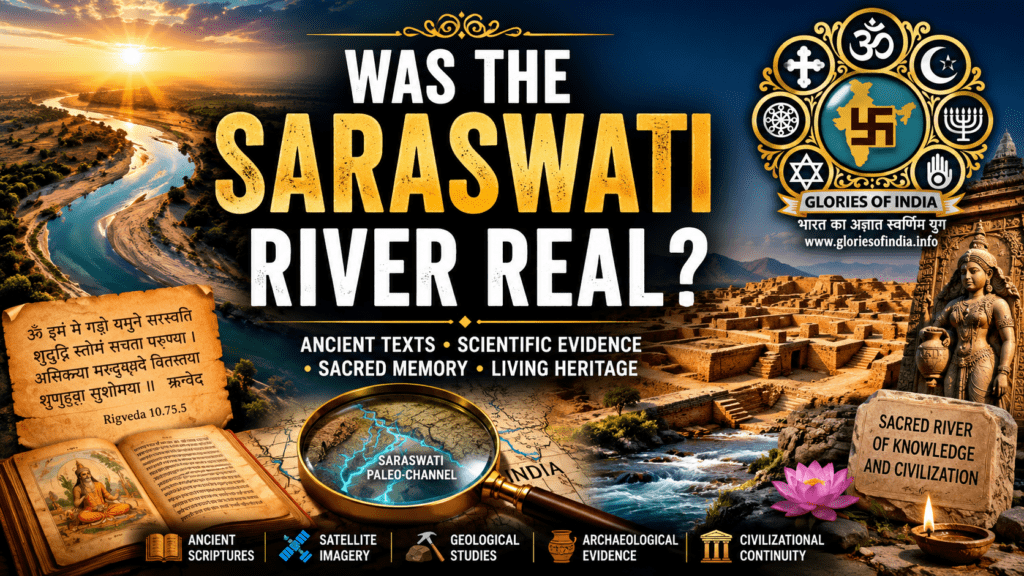
Among the many questions surrounding the history of ancient India, few have attracted as much attention as the Saraswati River.
For centuries, the Saraswati has been revered in Indian literature, rituals, and collective memory. It is praised repeatedly in the Rigveda as a mighty river and continues to be invoked in prayers performed across India even today.
Yet for many years, it was widely argued that the Saraswati was only a mythical river that never existed.
Over the past few decades, however, discoveries from geology, satellite imagery, archaeology, and hydrology have renewed interest in this question.
Rather than asking whether tradition or science is correct, researchers today increasingly ask a more constructive question:
What does the available evidence tell us?
Saraswati in Ancient Texts
The Rigveda contains numerous references to Saraswati, describing it as a powerful and life-giving river.
Later texts, including the Mahabharata, various Puranas, and pilgrimage traditions, also refer to Saraswati, although some describe sections of the river disappearing beneath the earth before joining other river systems.
For thousands of years, the river has remained part of India’s living cultural memory.
Even today, the name Saraswati is invoked in traditional rituals and prayers alongside rivers such as the Ganga, Yamuna, Godavari, Narmada, Sindhu, and Kaveri.
The continuity of this tradition raises an important historical question:
Did these references preserve memories of an actual river system?
Scientific Investigations
Modern technology has transformed the study of ancient landscapes.
Satellite imagery, remote sensing, geological surveys, sediment analysis, and hydrological studies have identified extensive paleo-channels across northwestern India and adjoining regions.
Many of these ancient river courses broadly correspond with descriptions found in historical traditions.
Researchers continue to debate the precise chronology, sources of water, and the river’s evolution over time.
Some studies suggest that major Himalayan-fed rivers may once have contributed to this system before geological changes altered their courses.
Although important questions remain, scientific investigation has significantly expanded the evidence available for understanding the region’s ancient hydrology.
Archaeology Along the Ancient River System
One of the most intriguing aspects of the Saraswati debate is the distribution of ancient settlements.
A large number of archaeological sites associated with the Indus–Saraswati Civilization are located along the dry river channels identified through geological research.
These settlements demonstrate that substantial human communities flourished in these regions for thousands of years.
The relationship between ancient habitation patterns and former river systems continues to be an active area of research.
Rather than viewing archaeology and geology separately, scholars increasingly study them together to reconstruct ancient landscapes.
Why the Debate Continues
Historical research rarely produces simple answers.
The Saraswati question involves multiple disciplines:
- Ancient literature
- Archaeology
- Geology
- Hydrology
- Remote sensing
- Climate science
- Geography
Each contributes a different piece of the puzzle.
As new evidence emerges, interpretations evolve.
This is how scientific inquiry progresses.
The objective is not to defend preconceived conclusions but to build a more accurate understanding based on cumulative evidence.
Why Saraswati Matters
The significance of Saraswati extends beyond the history of a single river.
It touches larger questions about civilization, environmental change, migration, settlement patterns, and the preservation of cultural memory.
If ancient traditions preserved knowledge of landscapes that later changed dramatically, they may contain valuable historical insights worthy of careful study.
Understanding the Saraswati also encourages collaboration across disciplines, combining traditional knowledge with modern scientific methods.
Such collaboration enriches both historical scholarship and public understanding.
A Continuing Journey of Discovery
The story of the Saraswati River is still unfolding.
New archaeological discoveries, improved satellite technology, sediment analysis, and interdisciplinary research continue to add new pieces to the puzzle.
Whether viewed through the lens of literature, science, or cultural memory, the Saraswati remains one of the most fascinating subjects in the study of ancient India.
Perhaps the most valuable lesson is not whether every question has already been answered.
It is that genuine scholarship welcomes new evidence, asks better questions, and remains open to discovery.
Key Takeaways
- Saraswati occupies a central place in India’s literary and cultural traditions.
- Modern scientific investigations have identified extensive ancient river channels in northwestern India.
- Archaeological settlements along these paleo-channels make the region historically significant.
- Understanding Saraswati requires collaboration between multiple disciplines.
- The search for evidence continues, making Saraswati one of the most important subjects in the study of ancient Indian civilization.