

For more than three decades, I have explored archaeological discoveries, historical landscapes and scientific research that illuminate the story of Indian civilization.
Among all the archaeological sites of the Indus–Saraswati Civilization, Rakhigarhi occupies a place of extraordinary importance.
Its immense size, sophisticated urban planning and groundbreaking scientific discoveries continue to reshape our understanding of one of humanity’s earliest urban civilizations.
Introduction
History occasionally uncovers places that force us to rethink everything we thought we knew.
Rakhigarhi is one such place.
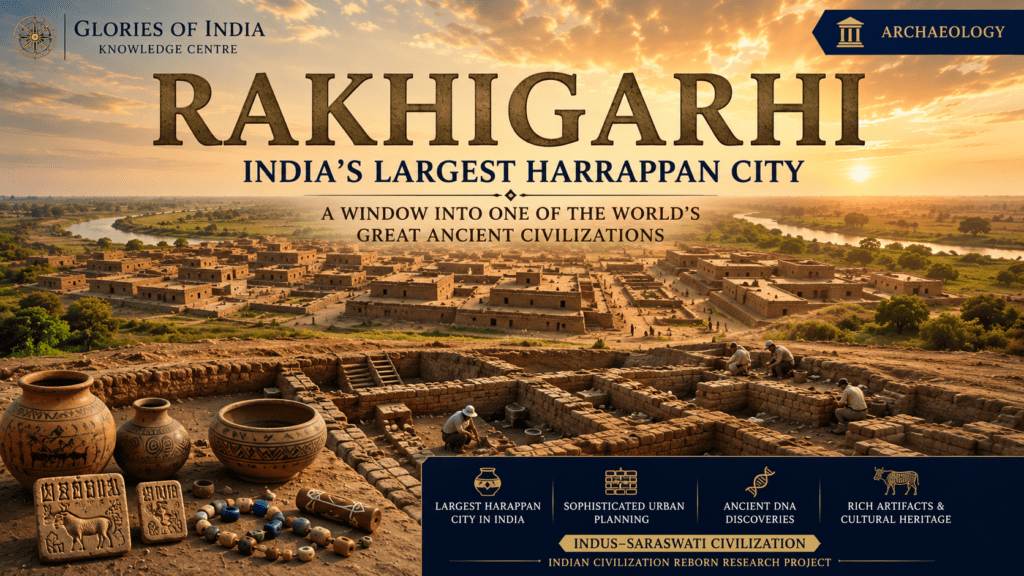
Located in Haryana, India, this vast archaeological site has emerged as the largest known city of the Indus–Saraswati Civilization, covering an area even larger than Harappa and comparable to Mohenjo-daro.
Yet Rakhigarhi is far more than an ancient city.
It is a laboratory where archaeology, genetics, geology and environmental science come together to tell the story of an advanced civilization that flourished thousands of years ago.
Where Is Rakhigarhi?
Rakhigarhi is situated in Hisar district, Haryana, within the ancient Ghaggar river basin.
The site consists of several interconnected mounds spread across a large area, reflecting centuries of urban growth and continuous habitation.
Its location places it within the broader cultural landscape often associated with the Indus–Saraswati Civilization.
Discovery and Excavation
Although local people had long known of ancient remains, systematic archaeological investigations revealed the true scale of Rakhigarhi.
Excavations by the Archaeological Survey of India (ASI) and later research teams uncovered:
- Residential neighbourhoods
- Planned streets
- Drainage systems
- Brick architecture
- Industrial areas
- Granaries
- Pottery workshops
- Bead-making centres
- Burial grounds
These discoveries demonstrate an exceptionally organised urban society.
A City Planned with Precision
One of Rakhigarhi’s greatest achievements is its urban planning.
Archaeologists have documented:
- Straight streets
- Standardised brick construction
- Sophisticated drainage
- Water management systems
- Craft production zones
- Residential planning
Such features reveal careful civic organisation and engineering expertise.
Scientific Discoveries
Modern archaeology extends far beyond excavation.
Researchers studying Rakhigarhi have used:
- Radiocarbon Dating
- Ancient DNA Analysis
- Isotope Studies
- Ceramic Analysis
- Geoarchaeology
- Palaeobotany
- Environmental Reconstruction
Together these disciplines provide an increasingly detailed picture of daily life thousands of years ago.
Ancient DNA Research
Among the most widely discussed discoveries from Rakhigarhi has been the study of ancient human DNA.
These investigations have contributed to ongoing discussions about:
- Population history
- Migration
- Cultural continuity
- Early farming communities
- Human genetics
Like all scientific research, these studies continue to evolve as additional samples and improved techniques become available.
Daily Life at Rakhigarhi
Excavations suggest that the inhabitants lived in a well-organised urban environment.
Evidence points to:
- Agriculture
- Animal husbandry
- Pottery production
- Jewellery making
- Trade
- Textile activities
- Skilled craftsmanship
The city appears to have supported a thriving and economically diverse population.
Connection with the Saraswati Civilization
Rakhigarhi lies within the broader region containing numerous settlements located near ancient river systems identified through geological and satellite studies.
This geographical relationship has become an important area of research into the environmental foundations of early urban development.
Understanding Rakhigarhi therefore contributes directly to our understanding of the Saraswati Civilization.
Why Rakhigarhi Matters
Rakhigarhi is significant because it challenges outdated assumptions.
It demonstrates that:
- Large urban centres flourished in Ancient Bharat.
- Sophisticated planning existed thousands of years ago.
- Scientific research continues to expand our understanding of early civilization.
- Archaeology is continually rewriting history.
Author’s Assessment
After studying the available archaeological evidence, excavation reports and scientific research for many years, I believe Rakhigarhi stands among the most important archaeological discoveries in the study of Indian civilization.
Its scale, planning and scientific significance demonstrate that Ancient Bharat was home to one of the world’s great urban traditions.
As research continues, Rakhigarhi will undoubtedly play an even greater role in understanding humanity’s shared past.
Key Takeaways
✔ India’s largest known Harappan city.
✔ Sophisticated urban planning.
✔ Major archaeological discoveries.
✔ Important ancient DNA research.
✔ Critical site for understanding the Indus–Saraswati Civilization.
✔ Continues to transform our understanding of early civilization.
Frequently Asked Questions
Where is Rakhigarhi?
Rakhigarhi is located in Haryana, India.
Why is Rakhigarhi important?
It is India’s largest known Harappan city and one of the most significant archaeological sites in South Asia.
What has been discovered there?
Residential buildings, streets, drainage systems, pottery, workshops, burials and evidence of advanced urban planning.
Why is the DNA research important?
Ancient DNA studies provide valuable information about the people who lived at Rakhigarhi and contribute to broader discussions about early population history.
Is Rakhigarhi larger than Harappa?
Current archaeological evidence indicates that Rakhigarhi covers a larger area than Harappa and is among the largest known cities of the Indus–Saraswati Civilization.
Continue Exploring
- Bhirrana: The World’s Oldest Continuously Inhabited Settlement?
- Latest Satellite Evidence of the Saraswati River
- Why the Rigveda Describes Saraswati as a Mighty River
- Saraswati vs Indus Civilization
- Dholavira: Engineering a Desert Civilization
- Kalibangan Fire Altars
- Carbon Dating Explained
- Ancient Bharat Before Egypt and Mesopotamia
 FeaturedBOOK
Indian Civilization Reborn
Rakhigarhi occupies a central chapter in Indian Civilization Reborn, where archaeological discoveries, scientific studies, maps and historical evidence are brought together to explore the extraordinary continuity of Indian civilization.
Coming Soon
Author: Dinesh Chandra Rawat
Publisher: Glories of India Publications
About the Author
Dinesh Chandra Rawat is an author, environmentalist and independent researcher. Over more than 35 years, he has visited archaeological sites, museums and historical landscapes across India and the world. Through the Indian Civilization Reborn Research Project, he seeks to encourage evidence-based exploration of India’s civilizational heritage.
Website Links
Ancient Indian Science and Technology: What the Evidence Reveals
Ancient Indian Science and Technology: What the Evidence Reveals India’s…
How Historical Narratives Are Constructed
How Historical Narratives Are Constructed: Evidence, Selection and Interpretation History…
How New Evidence Changes Historical Understanding
How New Evidence Changes Historical Understanding Historical knowledge is neither…