

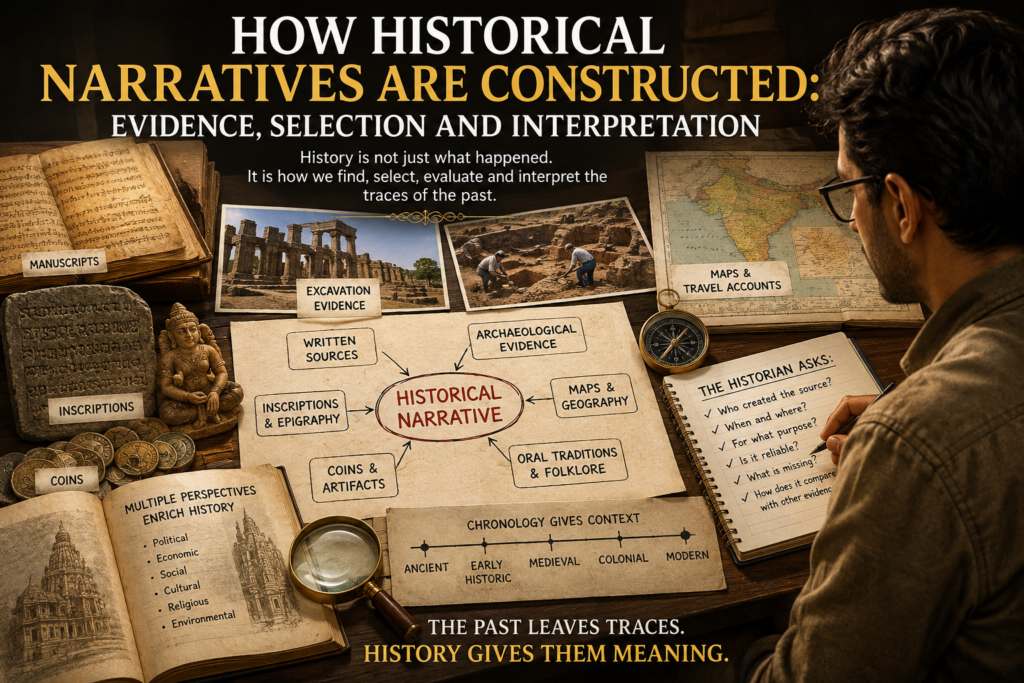
How Historical Narratives Are Constructed: Evidence, Selection and Interpretation
History is often imagined as a record of what happened.
Historical writing is more complicated.
The past contains an almost limitless number of events, experiences, individuals and material traces.
No historian can reproduce all of them.
A historical narrative therefore requires selection, organisation and interpretation.
This does not mean history is fictional.
It means historians construct explanations of the past from surviving evidence.
Understanding this process is essential when examining disagreements about Indian history.
The Past and History Are Not Identical
The past is everything that happened.
Historical evidence consists of traces of that past that survive.
History is the disciplined attempt to reconstruct and explain the past from those surviving traces.
This difference creates an unavoidable limitation.
Not everything survives.
Not everything that survives is discovered.
Not everything discovered is readable.
Not everything readable is equally reliable.
And historians inevitably ask particular questions of the available evidence.
Historical narratives therefore change when either the evidence or the questions change.
Step 1: Sources Survive Unequally
Imagine attempting to reconstruct a society two thousand years after it disappeared.
What might remain?
Perhaps royal inscriptions.
Coins.
Ruined buildings.
Religious literature.
Burial sites.
Pottery.
Foreign travellers’ descriptions.
A few administrative records.
Each source represents only part of society.
The ruler who commissions an inscription leaves a stronger documentary trace than the agricultural labourer who left no written account.
Stone survives differently from cloth.
Copper plates survive differently from palm-leaf manuscripts.
Dry climates preserve materials differently from humid climates.
Survival itself therefore affects historical visibility.
Step 2: Historians Select Questions
The same collection of evidence can support different legitimate research questions.
One historian may study political authority.
Another may investigate trade.
Another may examine agricultural systems.
Another may study women.
Another may analyse religious institutions.
Another may reconstruct climate and settlement.
The evidence does not necessarily change.
The question changes what becomes visible within the evidence.
This explains why historical scholarship can change even without a spectacular new archaeological discovery.
Step 3: Chronology Organises the Evidence
History requires time.
But periodisation is itself an analytical tool.
Terms such as:
- Ancient India
- Early Historic India
- Medieval India
- Colonial India
- Modern India
help organise enormous quantities of information.
Yet these divisions can also shape interpretation.
Political change did not occur simultaneously everywhere.
A dynasty might end without transforming village life.
Trade networks might cross political boundaries.
Intellectual traditions can continue through periods that political histories treat as separate eras.
Period labels are therefore useful—but they should not be mistaken for natural walls in the past.
Step 4: Language Shapes Perception
The words used to describe historical processes matter.
Consider terms such as:
“invasion”
“migration”
“assimilation”
“conquest”
“expansion”
“decline”
“collapse”
“continuity”
Each carries implications. Different terms may emphasise different mechanisms.Responsible historiography therefore asks whether the chosen vocabulary accurately represents the evidence or silently introduces assumptions.
Step 5: Evidence Must Be Contextualised
A source cannot simply be quoted.
Historians ask:
Who produced it?
When?
For whom?
For what purpose?
Was the writer an eyewitness?
Was the text written centuries later?
Was the inscription intended as royal praise?
Was a traveller unfamiliar with local customs?
Is the archaeological layer securely dated?
Could an artefact have moved from its original context?
Historical interpretation becomes stronger when these questions are answered explicitly.
Step 6: Different Sources Are Compared
The most persuasive reconstruction usually does not depend on one isolated piece of evidence.
Suppose a written source describes an important settlement.
Researchers may ask:
Does archaeology indicate habitation during the relevant period?
Do inscriptions mention the place?
Are coins present?
Do environmental studies make the described geography plausible?
Do other contemporary sources refer to it?
Agreement among independent forms of evidence can strengthen a conclusion.
Disagreement can identify a problem requiring further research.
Indian History Offers Powerful Examples
The history of Indian historical research itself demonstrates how narratives change.
The Indus Civilization
The recognition of Harappa and Mohenjo-daro as remains of a major Bronze Age civilization profoundly expanded modern understanding of ancient South Asia.
Prior to excavation and systematic comparison of material from the sites, historians did not possess the archaeological framework that later became fundamental to discussions of the subcontinent’s ancient urban past.
The ancient civilization had always existed. The modern historical narrative changed because the evidence base changed.
Brahmi and Inscriptional Evidence
A similar transformation followed progress in deciphering ancient inscriptions.
Once Brahmi inscriptions became readable to modern scholarship, material that had survived physically could be incorporated far more effectively into historical reconstruction.
Political history, religious history, administrative practices and networks of patronage could be examined through evidence that had previously been inaccessible linguistically.
These examples demonstrate a basic principle:
historical knowledge depends partly on what a generation is capable of recovering and interpreting.
Does This Mean History Is Merely Subjective?
No.
Interpretation does not mean that every interpretation is equally convincing.
Historical claims can be evaluated.
Researchers can ask:
Does the evidence exist?
Is it authentic?
Is it correctly dated?
Has relevant contrary evidence been considered?
Does the conclusion go beyond what the evidence can support?
Can another researcher check the sources?
Are alternative explanations plausible?
A strong historical narrative is therefore constrained by evidence even though interpretation is involved.
Why Competing Interpretations Exist
Historians can examine the same material and disagree.
Sometimes one side has overlooked evidence.
Sometimes the evidence is genuinely incomplete.
Sometimes researchers assign different importance to different sources.
Sometimes new information resolves the disagreement.
Sometimes uncertainty remains.
Academic disagreement is therefore not evidence that historical research has failed.
It is often the mechanism through which arguments are tested.
The Special Problem of Public History
Public discussions usually demand short answers.
Was something true or false?
Did an event happen or not?
Who was right?
Who was wrong?
Serious historical research often gives a more complicated answer.
“This evidence is secure.”
“This interpretation is probable.”
“This point remains contested.”
“The dating is uncertain.”
“Different sources disagree.”
Such language may appear less dramatic.
But it is often more accurate.
How Readers Can Evaluate Historical Claims
When encountering a striking claim about Indian history, ask seven questions:
1. What is the original evidence?
2. How securely is it dated?
3. Who interpreted it?
4. Is the interpretation widely accepted, disputed or new?
5. What evidence might contradict it?
6. Is the claim larger than the evidence justifies?
7. What discovery would cause us to change our conclusion?
These questions work regardless of ideology.
They can be applied equally to colonial interpretations, nationalist interpretations, Marxist interpretations, religious interpretations and popular social-media claims.
Conclusion
Historical narratives are constructed—but not invented at will.
They emerge from a disciplined process of:
evidence → selection → contextualisation → comparison → interpretation → argument.
Because the available evidence changes, narratives can change.
Because questions change, overlooked evidence can acquire new significance.
Because interpretations can be challenged, historical explanations remain open to correction.
For Indian history, this is not a weakness.It is an opportunity.
A civilization with a vast archaeological, textual, inscriptional and cultural record deserves not a frozen narrative but an ongoing evidence-based investigation.