

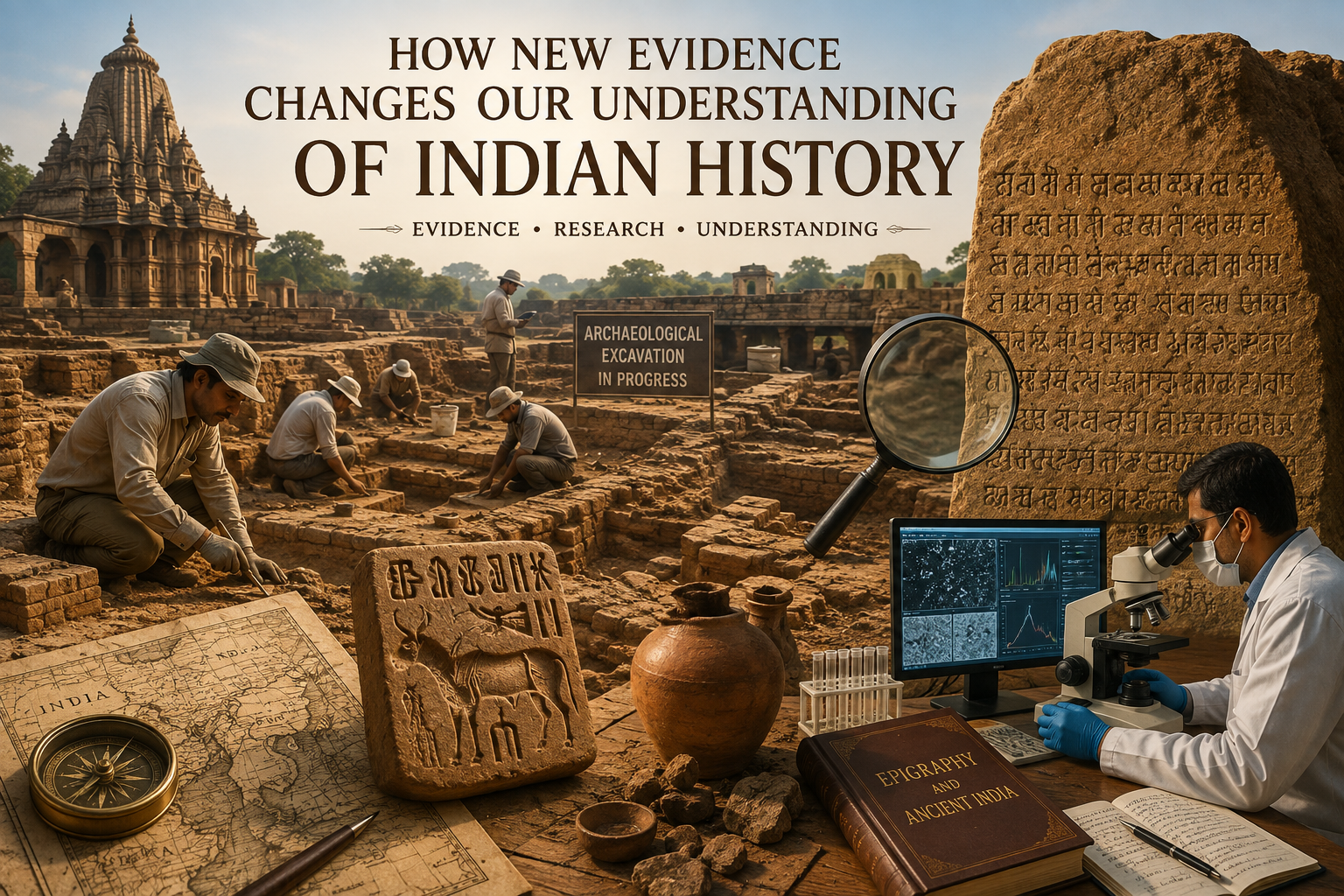
 How New Evidence Changes Historical Understanding
Historical knowledge is neither arbitrary nor permanently frozen.
It develops through a continuing relationship between evidence, method and interpretation.
A historical conclusion considered reasonable in one generation may later require modification because new sources appear, scientific techniques improve, archaeological discoveries expand the available record, or historians ask different questions of evidence that was already known.
Understanding this process is particularly important in the study of India, where archaeology, inscriptions, literary traditions, environmental evidence and modern scientific techniques contribute to the reconstruction of an exceptionally long and complex past.
History Is an Evidence-Based Reconstruction
Historians cannot directly observe most events they study.
They reconstruct them from surviving traces.
These may include:
- written documents;
- inscriptions;
- coins;
- archaeological remains;
- architecture;
- artworks;
- oral accounts;
- environmental evidence;
- demographic and economic data;
- scientific analysis of ancient materials.
No single category automatically provides a complete picture.
A royal inscription may provide names, titles and political claims but reveal little about village life.
Archaeological remains may show settlement patterns without explaining how inhabitants understood themselves.
Literary texts can preserve intellectual and cultural worlds while presenting challenges of chronology, transmission and genre.
Historical understanding therefore develops by comparing different types of evidence.
Why New Evidence Matters
New evidence can affect history in several ways.
1. It Can Reveal Something Previously Unknown
The archaeological recognition of the Indus or Harappan Civilization is a major example.
Excavations at Harappa and Mohenjo-daro in the early twentieth century demonstrated the existence of a major Bronze Age urban civilization in the northwestern subcontinent.
This did not merely add two archaeological sites to textbooks.
It transformed the framework within which the ancient history of the subcontinent had to be considered.
2. It Can Expand a Known Historical Landscape
Once a civilization or cultural complex is recognised, additional surveys and excavations can reveal that it covered a larger area or contained greater regional variation than originally assumed.
Indian archaeology has repeatedly expanded from famous sites toward networks of settlements, production centres, trade routes, water systems and agricultural landscapes.
The historical question consequently shifts from:
“What was this city?”
to broader questions such as:
“How did this regional system operate?”
3. It Can Introduce New Categories of Evidence
Modern historical research uses tools that earlier scholars did not possess.
These can include:
- radiocarbon dating;
- archaeobotany;
- zooarchaeology;
- palaeoenvironmental analysis;
- isotope studies;
- ancient DNA;
- remote sensing;
- satellite imagery;
- GIS-based landscape reconstruction;
- material and metallurgical analysis.
These methods do not eliminate interpretation.
They provide additional evidence that interpretations must accommodate.
The Importance of Inscriptions
Epigraphy provides another illustration of how access to evidence changes historical knowledge.
An inscription may remain physically visible while its script becomes unreadable.
Once decipherment occurs, a stone surface can suddenly provide names, administrative information, donations, religious affiliations, political claims or geographical references.
The nineteenth-century decipherment of Brahmi was therefore enormously important for the reconstruction of early Indian history.
Today, digitisation offers another transformation.
The Archaeological Survey of India’s Bharat Shared Repository of Inscriptions—BharatSHRI—is intended to digitise estampages and make inscriptions, transcripts and related metadata more accessible to scholars and the public.
Access itself can stimulate new historical questions.
Excavation Is Still Producing Evidence
Indian archaeology is not a completed activity.
Excavations and archaeological projects continue across the country.
Sites can produce structural remains, burials, pottery, coins, beads, ornaments, tools and other materials.
Scientific samples may then undergo further validation.
The significance of this continuing work is straightforward:
Any historical model of ancient India must remain capable of incorporating evidence that has not yet been excavated or scientifically analysed.
That does not mean every new discovery overturns established history.
Most do not.
Some clarify.
Some extend.
Some complicate.
Occasionally, a discovery requires more substantial reconsideration.
Sanauli and the Importance of Careful Language
The excavations at Sanauli in Uttar Pradesh provide a useful example of why discovery and interpretation should be separated.
The Archaeological Survey of India reported coffin burials and copper-covered objects from excavations in the area, with preliminary dating around 2000–1800 BCE. Excavators interpreted certain vehicles as chariots.
Such discoveries are important.
But responsible historical discussion must distinguish:
What was physically excavated?
from
How should the object be interpreted?
and then from
What larger historical conclusions can reasonably be drawn from it?
The excitement of discovery should never eliminate methodological caution.
New Evidence Can Also Challenge Attractive Claims
Evidence-led history works in both directions.
A discovery may support an existing hypothesis.
It may also weaken one.
Scientific dating may reveal that an object is younger or older than expected.
Archaeology may fail to support a proposed reconstruction.
A text may turn out to have multiple chronological layers.
A dramatic interpretation may prove less secure after further excavation.
Historical openness therefore cannot mean:
“Accept every claim that makes the past older or more impressive.”
It means:
Apply the same evidentiary standard regardless of whether the result confirms or contradicts our expectations.
Why Historical Conclusions Are Provisional
Calling historical knowledge “provisional” does not mean that nothing can be known.
There are historical conclusions supported by enormous bodies of evidence.
Rather, provisional knowledge means that explanations remain open to correction if substantially better evidence becomes available.
This principle protects history from two dangers:
dogmatism—refusing to reconsider a conclusion;
and
speculation—treating possibilities as established facts.
The solution to both is stronger evidence.
What This Means for Indian History
India’s past should not be approached through a choice between inherited textbook narratives and civilizational pride.
It should be approached through an expanding evidence base.
Archaeology should be examined.
Texts should be contextualised.
Inscriptions should be documented.
Environmental evidence should be integrated.
Scientific results should be scrutinised.
Competing interpretations should be compared.
Levels of certainty should be stated clearly.
That is not an argument for endlessly rewriting history according to fashion.
It is an argument for allowing historical understanding to improve.
Conclusion
The past is fixed.
Our access to it is not.
A site waiting underground, an unread inscription, an uncatalogued manuscript or a new scientific method can add information that earlier historians simply did not possess.
The appropriate response is neither immediate rejection nor immediate celebration.
It is investigation.
Historical knowledge advances when new evidence is allowed to ask new questions of old conclusions.