

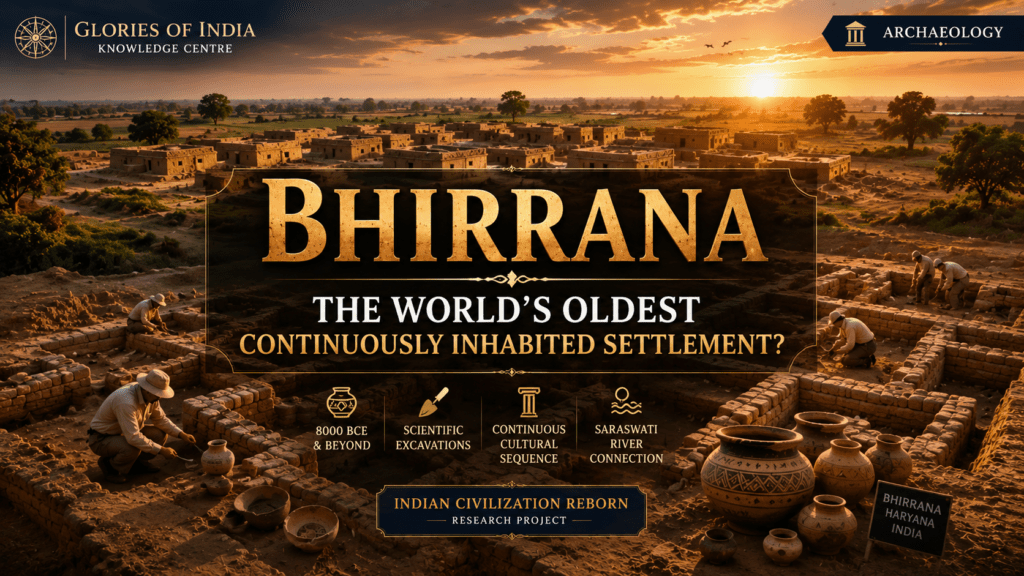
 Watch the documentary on our Glories of India YouTube Channel to explore archaeological evidence, satellite research, and the history of Ancient Bharat through detailed visual presentations.
Can One Small Village Rewrite Human History?
History is rarely rewritten overnight.
It changes quietly.
One excavation.
One discovery.
One carbon date.
One forgotten settlement.
For decades, school textbooks introduced Egypt and Mesopotamia as the earliest centres of civilization.
Yet, beneath the fertile plains of Haryana lies an archaeological site that is steadily challenging that narrative.
Its name is Bhirrana.
Although modest in appearance today, Bhirrana has become one of the most important archaeological sites in South Asia because its earliest occupation layers may extend back to nearly 8000 BCE.
If these findings continue to withstand scientific scrutiny, they suggest that settled life in the Indian subcontinent began far earlier than previously believed.
Why Bhirrana Matters
Archaeological discoveries are not judged merely by age.
They are judged by what they reveal about human development.
Bhirrana is remarkable because it preserves evidence from several successive cultural phases without major interruption.
Researchers have identified:
- Hakra Ware Culture
- Early Harappan
- Mature Harappan
- Late Harappan
This continuous sequence allows archaeologists to observe how one community gradually evolved over thousands of years.
Instead of isolated occupations, Bhirrana presents the story of an evolving civilization.
Where Is Bhirrana?
Bhirrana lies in Fatehabad District, Haryana, within the ancient basin of the Ghaggar River.
Many researchers associate this region with the broader Indus–Saraswati Civilization, which stretched across northwestern India and present-day Pakistan.
Its geographical location has attracted particular interest because numerous ancient settlements occur along buried river channels identified through modern satellite imagery.
 Excavations That Changed the Conversation
Excavations by the Archaeological Survey of India (ASI) uncovered a remarkable sequence of archaeological remains.
Among the discoveries were:
- Planned mud-brick houses
- Hearths
- Storage pits
- Handmade pottery
- Painted ceramics
- Copper artefacts
- Beads
- Stone tools
- Agricultural evidence
- Animal remains
Taken together, these findings reveal organised communities that developed gradually over many centuries.
 Scientific Dating
One of Bhirrana’s greatest strengths is that its chronology is supported by scientific investigation rather than historical tradition alone.
Researchers have used:
- Radiocarbon Dating
- Optically Stimulated Luminescence (OSL)
- Ceramic Analysis
- Stratigraphy
- Geoarchaeological Studies
Several published studies have suggested dates approaching 7500–8000 BCE for the earliest occupation levels.
These dates continue to be examined and refined, but they have already expanded scholarly discussions about the antiquity of settlement in the Indian subcontinent.
Related Video: Learn how radiocarbon dating, OSL dating, and archaeological evidence help determine the age of Bhirrana on the Glories of India YouTube Channel.
 The Saraswati Connection
Perhaps the most fascinating aspect of Bhirrana is its environmental setting.
The settlement lies close to ancient palaeochannels identified through satellite imagery.
These buried river systems have become central to ongoing research concerning the ancient Saraswati River.
If dependable rivers flowed through this region during the earliest phases of settlement, they would have provided ideal conditions for agriculture, trade and permanent habitation.
Understanding Bhirrana therefore contributes directly to our understanding of the wider Saraswati Civilization.
For visual explanations of the Saraswati River, satellite imagery, and the Ghaggar-Hakra system, visit the Glories of India YouTube Channel.
How Does Bhirrana Compare with Other Ancient Settlements?
Bhirrana does not stand alone.
It belongs to a remarkable family of ancient archaeological sites across the world.
Ancient Settlement | Approximate Earliest Occupation |
Jericho | c. 9000 BCE |
Bhirrana | c. 7500–8000 BCE (published archaeological studies) |
Çatalhöyük | c. 7400 BCE |
Mehrgarh | c. 7000 BCE |
Early Egypt | Later |
Early Mesopotamia | Later |
The exact chronology of each site continues to evolve as new scientific research becomes available.
Author’s Assessment
After studying archaeological literature, scientific dating, geological evidence and the broader context of Indian civilization for more than 35 years, I believe the available evidence supports a remarkable conclusion:
Bhirrana deserves serious consideration as the world’s oldest continuously inhabited settlement discovered so far.
This conclusion is based not on a single excavation or isolated date, but on the cumulative evidence presented by archaeology, scientific dating and cultural continuity.
As research continues, new discoveries may refine our understanding. Until then, Bhirrana stands as one of the strongest archaeological candidates for this distinction.
Readers are encouraged to examine the evidence and reach their own informed conclusions.
Why This Discovery Matters
The significance of Bhirrana extends beyond one archaeological site.
It encourages us to ask larger questions.
- When did civilization really begin?
- How did early farming communities evolve?
- What role did rivers play?
- Was civilization more geographically diverse than previously believed?
- How should we understand the antiquity of Ancient Bharat?
These are questions that continue to inspire archaeological research across the world.
Timeline
8000 BCE (Approx.)
Earliest occupation layers at Bhirrana.
↓
Development of Hakra Ware communities.
↓
Early Harappan culture.
↓
Mature Harappan civilization.
↓
Late Harappan occupation.
↓
Modern archaeological excavation.
↓
Scientific dating.
↓
Continuing international research.
Key Takeaways
✔ Bhirrana preserves one of the longest cultural sequences in South Asia.
✔ Scientific dating suggests exceptionally early settlement.
✔ Excavations reveal continuous human occupation through multiple cultural phases.
✔ Its location contributes significantly to Saraswati research.
✔ Bhirrana has become one of the most important archaeological sites in understanding the origins of Indian civilization.
Frequently Asked Questions
Where is Bhirrana?
Bhirrana is located in Fatehabad District, Haryana, India.
Why is Bhirrana famous?
Because archaeological excavations suggest extremely early human settlement associated with the Indus–Saraswati cultural tradition.
Is Bhirrana older than Harappa?
The earliest occupation levels at Bhirrana predate the Mature Harappan urban period.
How was Bhirrana dated?
Through radiocarbon dating, OSL dating, ceramic studies and archaeological stratigraphy.
Is Bhirrana the world’s oldest settlement?
Several ancient settlements, including Jericho and Çatalhöyük, are among the world’s earliest. Based on the evidence discussed here, I believe Bhirrana deserves serious consideration as the world’s oldest continuously inhabited settlement discovered so far.
Continue Exploring
- Latest Satellite Evidence of the Saraswati River
- Why the Rigveda Describes Saraswati as a Mighty River
- Saraswati vs Indus Civilization
- Rakhigarhi DNA Explained
- The Ghaggar-Hakra Debate
- Kalibangan: Fire Altars and Ritual Traditions
- Dholavira: Engineering a Desert Civilization
- Ancient Bharat Before Egypt and Mesopotamia
 From the Forthcoming Book
Indian Civilization Reborn
Bhirrana occupies a central place in Indian Civilization Reborn, where archaeological evidence, scientific dating, ancient literature and environmental studies are brought together to explore the extraordinary antiquity and continuity of Indian civilization.
Coming Soon
Author: Dinesh Chandra Rawat
Publisher: Glories of India Publications
About the Author
Dinesh Chandra Rawat is an independent researcher, author and environmentalist. Over more than 35 years, he has visited archaeological sites, museums and historical landscapes across India and many other countries. His work integrates archaeology, geology, ancient literature and environmental history to encourage a deeper, evidence-based understanding of Indian civilization.
Website Links
BOOKS
Rakhigarhi Ancient DNA: What the Evidence Actually Tells Us
What Does Rakhigarhi Ancient DNA Actually Tell Us About the…
Dholavira and the Engineering of Water: What the Archaeology Actually Shows
Dholavira and the Engineering of Water: What the Archaeology Actually…
How Old Is Bhirrana? What the Archaeological Dating Actually Shows
How Old Is Bhirrana? What the Archaeological Dating Actually Shows…