

Ancient Civilizations, Forgotten Knowledge, Archaeological Questions and the New Search for India’s Intellectual Past
For generations, ancient India was often introduced through kingdoms, dynasties, battles and religious traditions. Yet archaeology and the history of science reveal another India—one of planned cities, sophisticated water systems, metallurgy, mathematical reasoning, astronomical observation and enduring intellectual traditions.
Some of this knowledge was never truly “lost.” It survived in texts, practices and scholarly traditions. Other aspects were forgotten, misunderstood, inadequately investigated or only rediscovered through archaeology.
Today, new excavations, scientific dating, satellite imagery, genetics, archaeometallurgy and systematic study of ancient texts allow researchers to ask questions about India’s past that earlier generations could not.
The result should not merely be a celebration of ancient achievements.
It should be an invitation to investigate them.
Ancient Civilizations Were More Sophisticated Than We Once Imagined
The archaeological discoveries at Harappa and Mohenjo-daro in the early twentieth century fundamentally changed perceptions of South Asian antiquity.
Here was an urban civilization characterized by planned settlements, standardized bricks, sophisticated drainage, craft specialization and long-distance trade.
Subsequent discoveries dramatically expanded that picture.
Sites such as Dholavira, Rakhigarhi, Kalibangan, Lothal, Banawali and Bhirrana demonstrated that this civilization occupied an enormous and environmentally diverse landscape.
The important question therefore changed.
It was no longer simply:
How old was Indian civilization?
Researchers increasingly had to ask:
What knowledge was necessary to create and sustain societies of this complexity?
Dholavira: When Water Management Becomes Engineering
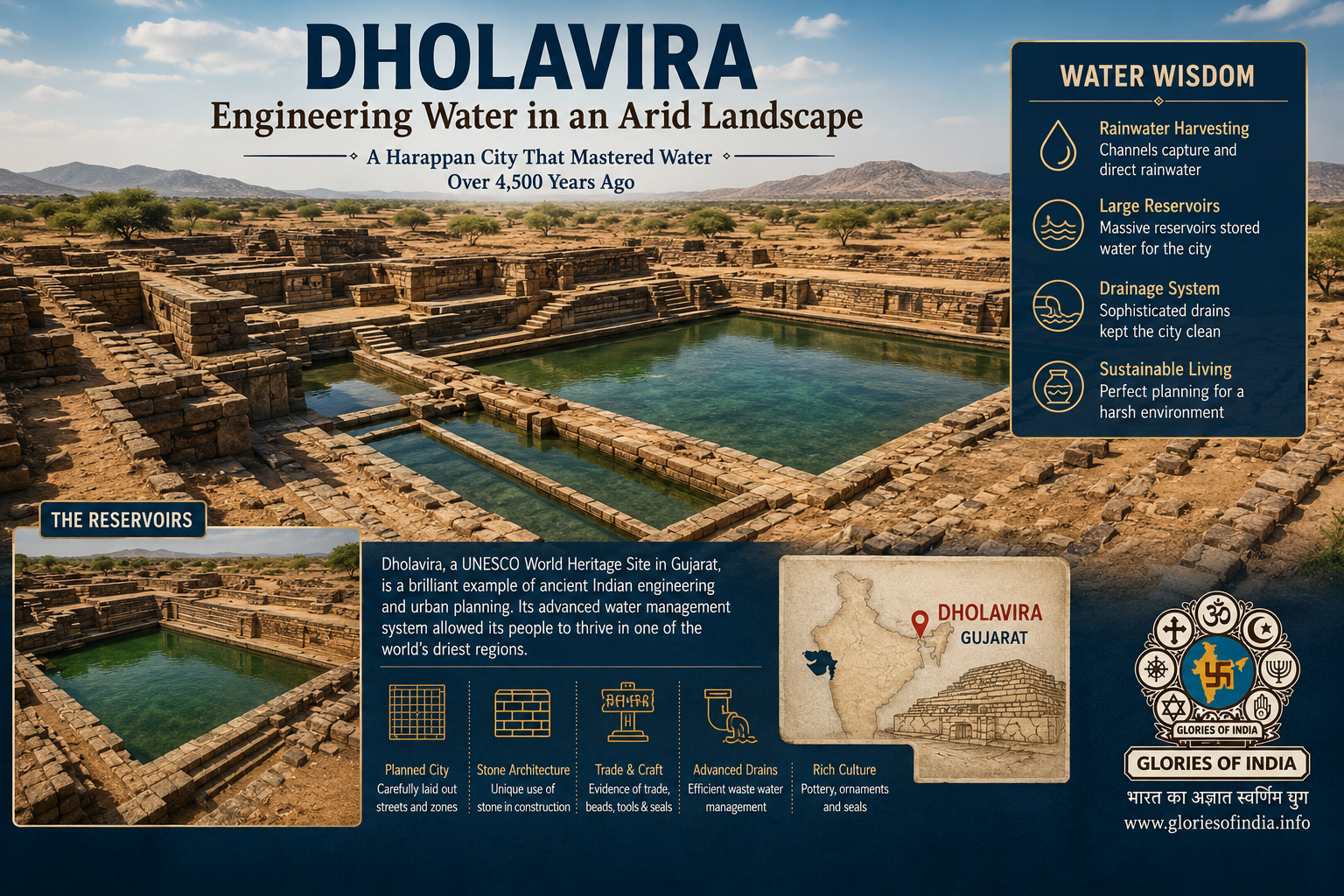
Few archaeological sites illustrate ancient Indian engineering better than Dholavira in present-day Gujarat.
Situated in the challenging environment of Kutch, Dholavira incorporated an elaborate system for capturing, directing and storing scarce water.
Reservoirs, drains and carefully planned urban structures reveal an extraordinary response to environmental conditions.
Such systems required practical understanding of:
- rainfall,
- topography,
- water flow,
- storage,
- construction materials,
- drainage,
- and seasonal conditions.
Dholavira reminds us that ancient knowledge was not confined to philosophical or scientific texts.
It was embedded in engineering and everyday survival.
Rakhigarhi and the Expanding Map of Ancient India
Rakhigarhi in Haryana has emerged as one of the most important Harappan archaeological sites.
Its scale helped demonstrate that major centres of the civilization existed well beyond what the traditional term “Indus Valley” might suggest.
Research associated with Rakhigarhi has also entered another remarkable field: ancient DNA.
Genetic evidence cannot answer every historical question. But when carefully combined with archaeology and anthropology, it provides another way of investigating ancient populations.
This is an excellent example of ancient history meeting modern scientific inquiry.
Questions once approached primarily through pottery, burials and architecture can now also be examined using genetics and other scientific techniques.
and the Question of Chronology
Bhirrana, also in Haryana, has attracted attention because excavations identified very early cultural levels.
Research connected with Bhirrana and its environmental setting has contributed to discussions concerning the chronology of early settlements and the development of Harappan cultural traditions.
Dating an ancient civilization, however, is rarely as simple as discovering one early date and declaring a settlement “the oldest.”
Archaeologists must distinguish between:
- earliest occupation,
- continuous habitation,
- cultural phases,
- development of urbanism,
- and dates produced by different materials and methodologies.
That distinction is important.
But Bhirrana nevertheless reminds us that the roots of settled communities in this region reach deep into antiquity and deserve continued investigation.
The Saraswati Question: When Text, Landscape and Archaeology Meet
One of India’s most fascinating archaeological questions concerns the Saraswati River described prominently in ancient literature.
Across Haryana, Rajasthan and Cholistan lies the Ghaggar-Hakra system together with networks of ancient paleochannels.
Researchers employ satellite imagery, sediment analysis, geomorphology, groundwater studies, archaeology and remote sensing to reconstruct how rivers flowed through this landscape thousands of years ago.
Numerous Harappan settlements occur along or near these ancient channels.
Whether particular Ghaggar-Hakra paleochannels can be identified directly with the Saraswati described in Vedic literature remains debated.
But the investigation itself is extraordinary:
Modern technology can now investigate geographical memories preserved in ancient traditions.
Ancient Metallurgy: The Iron Pillar Question
India’s metallurgical traditions provide another striking example.
The famous Iron Pillar of Delhi, dating broadly to the Gupta period, has survived for approximately sixteen centuries with remarkable resistance to corrosion.
Scientists have investigated its composition, manufacturing methods and protective surface characteristics to understand its durability.
Its significance does not depend on claims of mysterious technology.
The reality is sufficiently impressive.
The pillar demonstrates sophisticated empirical knowledge of iron production and forging among ancient Indian metalworkers.
It raises a fascinating question:
How much technological knowledge was transmitted through craft traditions rather than through surviving written texts?
Archaeology sometimes preserves the products of knowledge even when the workshops, teachers and methods that produced them have disappeared.
Ancient Mathematics: Knowledge That Changed the World
India’s contribution to mathematics represents one of the strongest examples of an intellectual tradition with global consequences.
Indian mathematicians made major contributions to:
- decimal place-value notation,
- arithmetic,
- geometry,
- algebra,
- trigonometry,
- astronomical calculation,
- and mathematical treatments of zero.
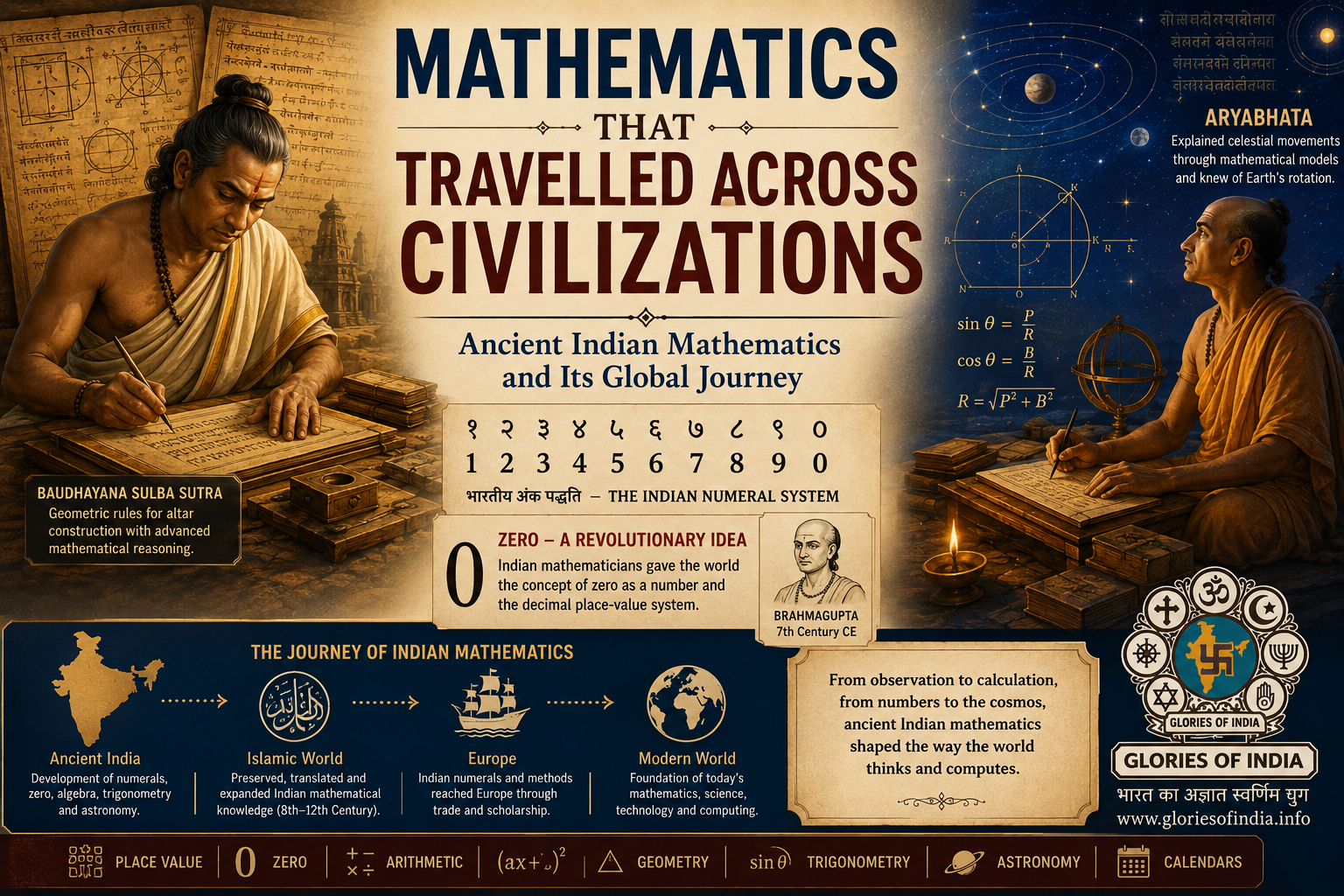
The history of zero involves developments across more than one civilization, but Indian mathematics played a decisive role in developing zero as a number within a decimal place-value computational tradition.
Brahmagupta, writing in the seventh century CE, formulated mathematical rules involving zero and negative quantities.
Indian numerals and mathematical methods subsequently travelled through scholarly networks into the Islamic world and eventually Europe.
What are commonly called “Arabic numerals” therefore belong to a much longer history of intellectual transmission in which Indian mathematical traditions played a foundational role.
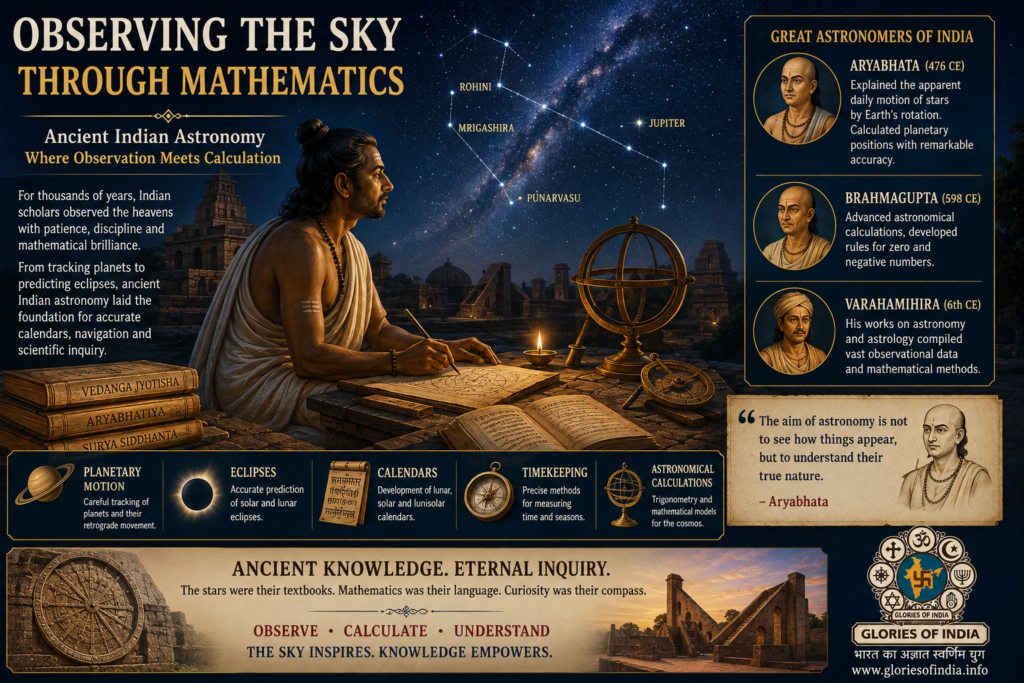
Looking at the Sky: India’s Astronomical Tradition
Astronomy requires something that no civilization can manufacture overnight:
long-term observation.
Indian scholars developed substantial traditions concerning:
- planetary motion,
- eclipses,
- calendars,
- lunar cycles,
- solar movement,
- mathematical astronomy,
- and timekeeping.
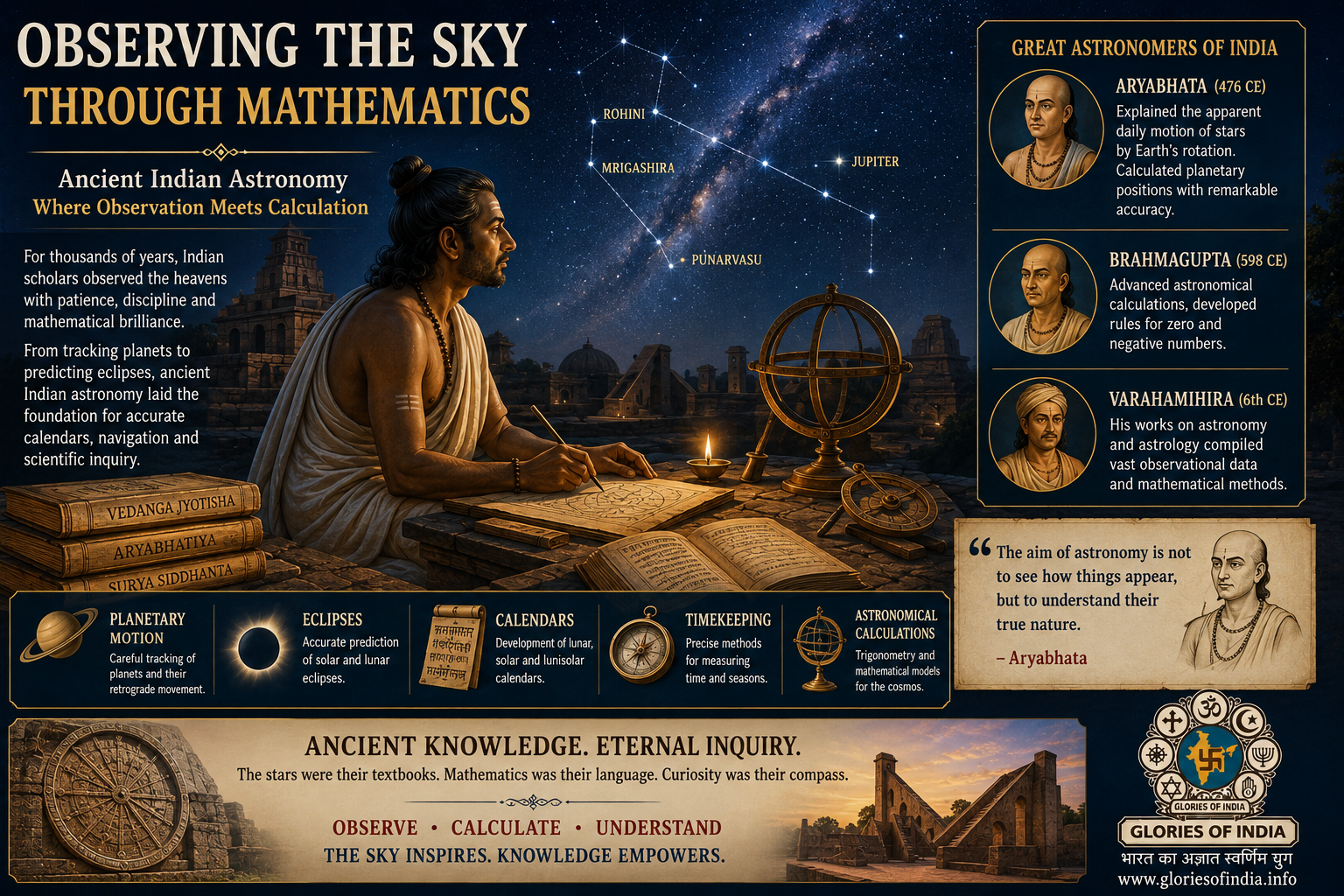
Aryabhata, writing around 499 CE, developed mathematical approaches to astronomical phenomena and discussed the apparent movement of the heavens in relation to Earth’s rotation.
Later scholars including Varahamihira, Brahmagupta and Bhaskara developed India’s astronomical and mathematical traditions further.
Astronomy and mathematics evolved together.
To understand the heavens, scholars needed mathematics.
And astronomical problems, in turn, stimulated mathematical innovation.
Geometry and the Sulba Sutras
The Sulba Sutras, associated particularly with geometrical procedures for constructing ritual altars, preserve sophisticated mathematical reasoning.
They contain procedures involving:
- squares,
- rectangles,
- circles,
- diagonals,
- transformations of areas,
- and geometric construction.
The Baudhayana Sulba Sutra includes a statement equivalent to the geometrical relationship later famously associated with Pythagoras.
This should not become a simplistic competition over who “invented” mathematics first.
Similar mathematical insights could develop independently in different civilizations.
The important historical point is that sophisticated geometrical reasoning existed in ancient India and deserves its proper place in the global history of mathematics.
Knowledge Was Not Divided Into Modern Departments
Today we divide knowledge into disciplines:
Mathematics | Astronomy | Medicine | Metallurgy | Architecture | Agriculture
Ancient systems were often considerably more interconnected.
Astronomy required mathematics.
Architecture required geometry.
Agriculture required understanding seasons.
Water management required knowledge of terrain and rainfall.
Medicine involved observation of plants, diet and the human body.
Metallurgy required experimentation with ores, temperatures and materials.
Knowledge grew through interactions among observation, calculation, craft, experience and philosophical inquiry.
Was Ancient Knowledge Really Forgotten?
The phrase “forgotten knowledge” requires careful interpretation.
Not everything disappeared.
Much survived through:
- manuscripts,
- oral traditions,
- craftspeople,
- physicians,
- astronomers,
- agricultural communities,
- architectural practices,
- and regional knowledge systems.
But historical disruption, changing institutions, loss of manuscripts, language barriers and the decline of some traditional centres of learning affected continuity.
Some claims concerning ancient India have subsequently been exaggerated.
Others may have been underestimated or insufficiently investigated.
Neither extreme serves history.
The answer is evidence-based inquiry.
Archaeology Is Asking Questions Earlier Generations Could Not
Twenty-first-century researchers possess tools earlier historians could scarcely imagine.
They include:
- radiocarbon dating,
- ancient DNA,
- isotope analysis,
- satellite remote sensing,
- GIS mapping,
- archaeobotany,
- archaeometallurgy,
- paleoclimatology,
- sediment analysis,
- geophysical investigation,
- and digital reconstruction.
A dry riverbed can be examined from space.
A human tooth can reveal information about diet, migration or ancestry.
Ancient seeds can illuminate agriculture.
Metal objects preserve evidence of manufacturing techniques.
Sediments can preserve the history of vanished rivers.
History is increasingly becoming a meeting ground between the humanities and sciences.
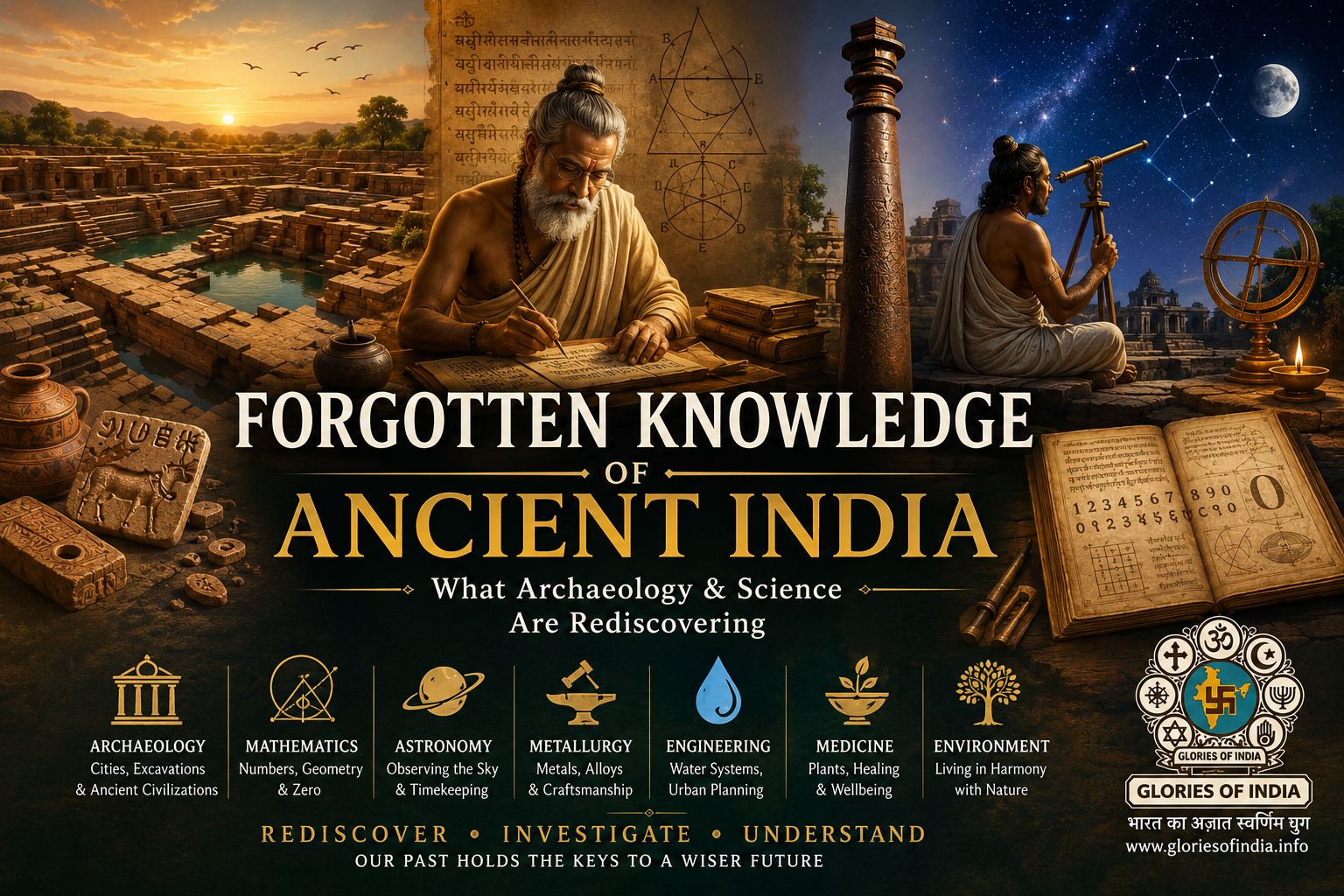
Ancient Knowledge and Modern Inquiry
There are two mistakes we should avoid.
The first is assuming that ancient people were primitive simply because they lived thousands of years ago.
The second is attributing every modern scientific achievement to antiquity without adequate evidence.
India’s genuine intellectual achievements are impressive enough without exaggeration.
The better question is:
What does the evidence actually demonstrate?
Where archaeology provides strong evidence, we should state it confidently.
Where ancient texts provide clues, we should investigate them seriously.
Where interpretations remain disputed, we should say so openly.
And where important questions remain unanswered, we should investigate further.
Why This Matters Today
Studying ancient knowledge is not an exercise in nostalgia.
It can contribute to modern understanding of:
- sustainable water management,
- climate adaptation,
- urban planning,
- mathematical development,
- scientific observation,
- materials technology,
- biodiversity,
- and the transmission of knowledge between civilizations.
Perhaps more importantly, it teaches intellectual humility.
Modern civilization possesses extraordinary technology.
But human curiosity, observation and ingenuity did not begin in modern times.
Every civilization inherited knowledge, developed it, transmitted some of it—and sometimes forgot parts of it.
Recovering that story is part of understanding humanity itself.
Frequently Asked Questions
Did ancient India possess advanced scientific knowledge?
Ancient India developed substantial traditions in mathematics, astronomy, medicine, metallurgy, architecture and several other fields. Individual claims should nevertheless be evaluated according to their specific textual, archaeological and scientific evidence.
Did India invent zero?
The history of zero involves developments in multiple civilizations. Indian mathematicians made a fundamental contribution by developing and systematically employing zero as a number within the decimal place-value mathematical tradition.
What archaeological discoveries demonstrate ancient Indian engineering?
Dholavira’s water-management systems, Harappan urban planning and drainage, metallurgical remains and numerous examples of sophisticated construction provide important evidence.
Can satellite imagery reveal ancient civilizations?
Satellite imagery can help identify paleochannels, landscape features and patterns that guide archaeological investigation. These observations generally require verification through fieldwork and other scientific methods.
Is modern science proving ancient Indian texts?
That statement is too broad. Modern research can investigate specific geographical, astronomical, archaeological or historical propositions connected with ancient texts. Some correlations may prove significant; others remain uncertain or disputed.
Conclusion: Rediscovery Should Begin With Questions
Ancient India left behind cities, monuments, mathematical texts, astronomical works, metallurgical achievements, medical traditions and philosophical inquiries of extraordinary depth.
Yet perhaps the greatest tribute we can pay to the people who created this knowledge is not simply to praise them.
It is to investigate them.
Archaeologists should continue digging.
Scientists should continue testing.
Historians should continue questioning.
Ancient texts should continue being examined alongside material evidence.
And assumptions—whether inherited from older historiography, modern nationalism or popular mythology—should remain open to examination.
The history of India is still being written because evidence is still emerging.
Some ancient knowledge survived.
Some has been rediscovered.
And some may still be waiting beneath the soil, inside forgotten manuscripts, along vanished rivers—or within questions previous generations never thought to ask.
The real glory of an ancient civilization is not that we believe everything claimed about it. It is that its achievements are important enough to keep investigating.

Rakhigarhi Ancient DNA: What the Evidence Actually Tells Us
What Does Rakhigarhi Ancient DNA Actually Tell Us About the…
Dholavira and the Engineering of Water: What the Archaeology Actually Shows
Dholavira and the Engineering of Water: What the Archaeology Actually…
How Old Is Bhirrana? What the Archaeological Dating Actually Shows
How Old Is Bhirrana? What the Archaeological Dating Actually Shows…