

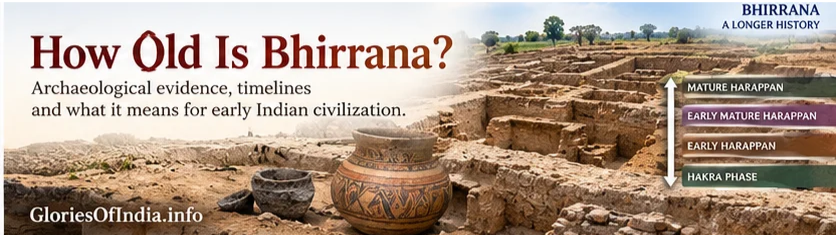
How Old Is Bhirrana? What the Archaeological Dating Actually Shows
Bhirrana has become one of the most discussed archaeological sites in debates about the antiquity of the Harappan cultural sequence.
The reason is simple: excavations revealed occupation beneath the better-known Early and Mature Harappan levels, and published dating studies have proposed very early dates for those lower deposits.
But an early date can easily be misunderstood.
Dating an early settlement is not the same thing as dating the fully developed Mature Harappan urban civilization.
To understand why Bhirrana matters, we need to look at the site’s stratigraphy—the sequence of cultural layers—and ask exactly what was found in each phase.
Why Bhirrana Matters
Bhirrana lies in Haryana’s Fatehabad district, within the wider Ghaggar–Hakra region. The Archaeological Survey of India excavated the site over several seasons in the early 2000s.
The excavation is important because it revealed a sequence extending from an early Hakra Ware horizon through Early Harappan, transitional or Early Mature Harappan, and Mature Harappan occupation.
The ASI’s 2005–06 excavation report explicitly describes four cultural periods: Period IA Hakra Ware Culture, Period IB Early Harappan, Period IIA Early Mature Harappan and Period IIB Mature Harappan. Read the ASI excavation report.
This layered sequence is more informative than any single headline date.
What Was Found in the Earliest Layer?
The lowest cultural horizon identified by the excavators is associated with Hakra Ware.
The ASI report describes subterranean dwelling pits in this phase, with plastered walls and floors, together with a varied ceramic assemblage. This is evidence of an early settled community with its own material culture.
Later levels show changes in settlement organization, architecture, crafts and material culture.
That sequence allows archaeologists to study development through time rather than treating the Harappan world as something that appeared suddenly in fully urban form.
What the Dating Actually Shows
A widely discussed 2016 study published in Scientific Reports compiled radiocarbon and optically stimulated luminescence dates from Bhirrana. It reported a mean radiocarbon age of about 8.35 ± 0.14 ka BP for the earliest dated level, corresponding in the paper to approximately 8,597–8,171 years before present. Read the Scientific Reports study.
The authors proposed a substantially extended chronology for Bhirrana, describing a Pre-Harappan Hakra phase around 9.5–8 ka BP, followed by Early Harappan, Early Mature Harappan and Mature Harappan phases.
The same paper reported OSL ages of about 5.9 ± 0.25 ka BP for pottery assigned to an Early Mature Harappan level and about 4.8 ± 0.3 ka BP for pottery assigned to a Mature Harappan level.
Earliest dated lower level: mean radiocarbon age about 8.35 ka BP in the 2016 study.
Early cultural horizon: Hakra Ware / pre-Early Harappan occupation.
Later development: Early Harappan → Early Mature Harappan → Mature Harappan cultural phases.
Key point: the oldest date belongs to the early occupation sequence; it is not a date for a fully developed Mature Harappan city.
Why “8,000 Years Old” Needs Explanation
When people hear that Bhirrana is more than 8,000 years old, they may assume that the Mature Harappan civilization—with its large planned cities, standardized material culture, seals, weights and extensive exchange networks—already existed in that same form at the earliest date.
That is not what the stratigraphy shows.
The excavation itself distinguishes the Hakra Ware horizon from Early Harappan and Mature Harappan levels.
This distinction is crucial.
An archaeological site can be extremely old because people occupied the location long before later urban characteristics developed.
Early settlement tells us about the roots and developmental history of a region. Mature urbanism is a later historical question.
Why the Chronology Requires Care
The 2016 chronology is important and deserves serious attention, but archaeological dates always have to be interpreted in relation to stratigraphic context, sample type, laboratory method and material culture.
Radiocarbon dating measures once-living material such as charcoal; OSL estimates the time since mineral grains were last exposed to sufficient light. Neither method automatically tells us what cultural label should be applied to a layer.
That label comes from archaeology.
This is one reason Bhirrana has generated debate: the early numerical dates and the cultural terminology used to describe the sequence must be evaluated together rather than collapsed into a single claim.
The ASI excavation sequence and the 2016 scientific dating study are therefore best read side by side.
A 2024 Study Adds Another Line of Evidence
Research on Bhirrana has continued. A 2024 paper in the Journal of Archaeological Science: Reports examined ancient cattle DNA from Bhirrana and described the site as containing deposits from a pre-Harappan/Hakra cultural horizon through the Mature Harappan period. The genetic study identified the analysed ancient cattle remains as Bos indicus. See the 2024 study.
This does not independently settle the site’s entire chronology, but it demonstrates how new scientific techniques continue to add evidence to archaeological interpretation.
What Bhirrana Changes About the Harappan Story
Bhirrana encourages us to think of the Harappan civilization as a long developmental process.
Urban civilizations do not normally appear overnight.
Settled communities, regional ceramic traditions, agricultural practices, craft production, exchange networks and increasingly complex settlement organization can develop over long periods before large urban centres emerge.
Bhirrana’s importance lies partly in preserving evidence relevant to that longer process in the Ghaggar–Hakra region.
This is also why the site belongs beside evidence from Dholavira , Rakhigarhi and the wider Ghaggar–Hakra landscape. No single site represents the entire civilization.
What the Evidence Does Not Prove
The early dates from Bhirrana should not be dismissed simply because they complicate familiar chronologies.
But they should not be made to prove more than the evidence supports.
They do not by themselves establish that a fully developed Mature Harappan urban civilization existed eight or nine thousand years ago.
They do not by themselves identify the language of the site’s inhabitants.
They do not settle every question about the relationship between the Harappan world and later Indian cultural traditions.
And they do not turn every proposed chronological extension into established consensus.
What they do provide is something extremely valuable: evidence that the early settlement history of this region deserves close attention and that the developmental background of the Harappan world may be longer and more complex than simplified textbook timelines suggest.
Why the Distinction Makes Bhirrana More Interesting
There is no need to exaggerate Bhirrana in order to appreciate it.
An early community living in the region, developing material traditions and participating in a sequence that eventually included Harappan urban culture is historically important in its own right.
The real story is not merely “How old is Bhirrana?”
The deeper question is:
What does Bhirrana reveal about the long process through which settlements, technologies and regional cultures contributed to the Harappan world?
That is a much richer question—and archaeology is still answering it.
Key Takeaways
- ASI excavations identified four major cultural phases at Bhirrana: Hakra Ware, Early Harappan, Early Mature Harappan and Mature Harappan.
- A 2016 study reported a mean radiocarbon age of about 8.35 ka BP for the earliest dated level and proposed still earlier bounds for the Hakra phase.
- The earliest occupation is not equivalent to a fully developed Mature Harappan urban city.
- Dating methods and archaeological cultural classification answer related but different questions.
- Bhirrana is important for studying the longer developmental background of the Harappan world in the Ghaggar–Hakra region.
- The evidence is significant without needing exaggerated claims.
Continue the Research
On GloriesOfIndia.info: Dholavira and the Engineering of Water · Rakhigarhi Ancient DNA ·The Ghaggar–Hakra Debate
Companion reflection: What Does It Mean for a Civilization to Continue? on DineshRawat.live.
Frequently Asked Questions
What is the earliest published date from Bhirrana?
The 2016 Scientific Reports paper reported a mean radiocarbon age of about 8.35 ± 0.14 ka BP for the earliest dated level and proposed a broader 9.5–8 ka BP range for the Pre-Harappan Hakra phase.
Does that mean the Mature Harappan civilization was already present at that date?
No. The excavated sequence distinguishes the early Hakra Ware horizon from later Early Harappan, Early Mature Harappan and Mature Harappan levels.
Why are the Bhirrana dates important?
They provide evidence relevant to early settlement and cultural development in the Ghaggar–Hakra region and raise important questions about the developmental background of the Harappan civilization.
Are the early dates universally accepted?
The dates are published scientific results, but their broader chronological and cultural interpretation requires continued archaeological evaluation. Numerical age, stratigraphic context and cultural classification should be considered together.
From Early Settlements to Civilization
Indian Civilization Reborn examines the longer evidence trail—archaeology, geography, environment, science, texts and living traditions—while distinguishing what is established from what remains open to investigation.
Research References
Archaeological Survey of India — Excavation at Bhirrana, 2005–06
Sarkar et al. (2016), Scientific Reports — Oxygen isotope in archaeological bioapatites from India