

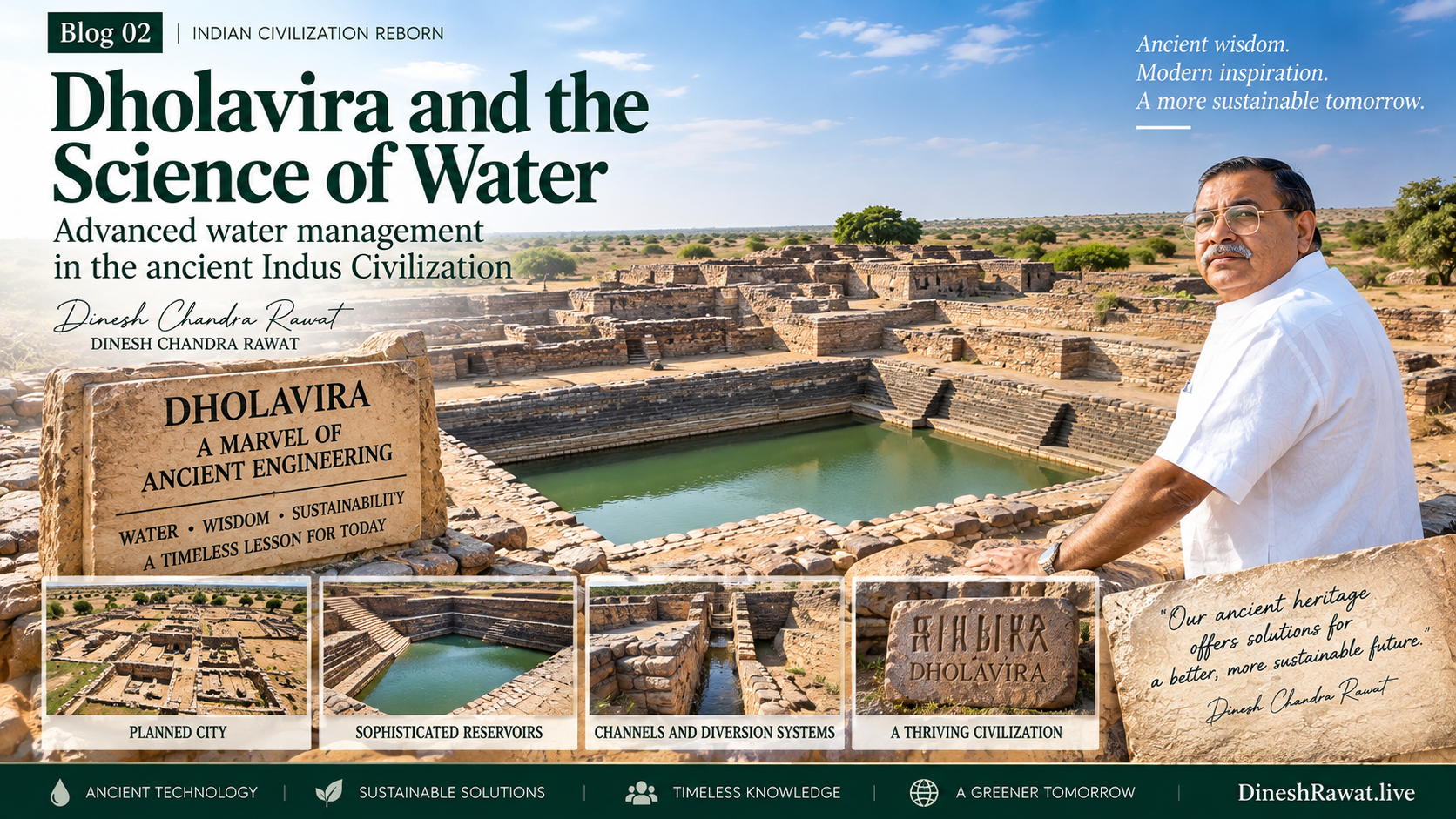
 Dholavira and the Engineering of Water: What the Archaeology Actually Shows
Ancient technological achievement is most convincing when we do not need exaggeration.
Dholavira is an excellent example.
Located on Khadir Island in present-day Gujarat, the Harappan city developed in an environment where reliable water was a fundamental challenge. The archaeological response to that challenge survives in reservoirs, channels, drains and the organisation of the settlement itself.
UNESCO, which inscribed Dholavira on the World Heritage List in 2021, describes its sophisticated water-management system and planned urbanism as defining technological achievements.
Why Dholavira Matters
Dholavira was occupied for roughly fifteen centuries, with UNESCO placing its occupation approximately between 3000 and 1500 BCE. Its remains include a fortified city, residential areas, workshops, a ceremonial ground, cemetery and substantial water-management infrastructure.
Its importance therefore lies not in a single spectacular artefact.
It lies in the organisation of an entire urban system.
Building a City Where Water Was Scarce
Unlike settlements benefiting from a major perennial river, Dholavira occupied an arid landscape.
Two seasonal streams were available, but seasonal water creates an engineering problem: water arriving at one time of year must be captured, directed, stored and managed for later use.
The inhabitants responded by integrating water management into the city.
UNESCO records a series of reservoirs to the east and south of the citadel and identifies technological advances in water harnessing and drainage as central features of the site.
This is significant because successful water storage requires more than digging a large pit. Builders need practical knowledge of terrain, runoff, gradients, construction, storage capacity and maintenance.
Reservoirs, Drains and Urban Planning
The archaeological significance of Dholavira emerges from the relationship between its systems.
Water management was connected with city planning.
Urban sectors, fortifications, streets, reservoirs and drainage were not isolated constructions accumulated randomly over time. UNESCO characterises Dholavira as an outstanding example of Harappan urban planning, including preconceived city planning, multi-layered fortifications, sophisticated reservoirs and drainage.
This suggests administrative capacity as well as engineering ability. Large public works require labour organisation, planning and the transmission of practical knowledge.
What Engineering Knowledge Was Required?
Archaeology cannot provide the lost engineering manual of Dholavira. But structures reveal capabilities.
To create functioning reservoirs and drains, builders had to work successfully with:
- elevation and gradient,
- seasonal water movement,
- storage,
- local building materials,
- structural stability,
- urban drainage,
- and repeated maintenance.
This is an important methodological point. Ancient technological knowledge was not always preserved in texts.
Sometimes the object itself is the surviving document.
What the Evidence Does Not Prove
Dholavira should also teach caution.
Its sophisticated infrastructure does not establish every modern claim made about ancient Indian technology.
Archaeology permits strong conclusions where physical evidence exists and weaker conclusions where it does not.
That distinction strengthens rather than diminishes India’s scientific heritage.
We do not need to describe Dholavira as possessing mysterious or impossibly advanced technology. Its documented achievement is impressive enough.
Dholavira and the Wider Harappan World
Dholavira was not isolated.
UNESCO notes evidence of manufacturing and inter-regional trade, including connections with other Harappan centres and regions associated with Mesopotamia and the Oman peninsula.
The wider Harappan world also demonstrates standardized construction, craft specialization and extensive settlement networks.
What systems of knowledge allowed complex urban communities to operate across such a large geographical region?
Why This Changes the Question We Ask
Older popular histories often present ancient civilizations primarily through rulers, wars and monuments.
Dholavira suggests another way to examine civilization.
Look at infrastructure. Look at water. Look at adaptation. Look at the knowledge embedded in ordinary survival.
A civilization’s intellectual history does not exist only in manuscripts.
Civilization is not only written in texts. Sometimes it is carved into reservoirs.
At Dholavira, water engineering gives us an unusually durable record of practical intelligence in the Harappan world.
Key Takeaways
- Dholavira was a major planned Harappan urban settlement.
- Water scarcity was addressed through sophisticated harvesting, storage and drainage infrastructure.
- UNESCO specifically identifies its water-management system as a major technological achievement.
- Archaeological structures demonstrate practical engineering knowledge even where technical manuals have not survived.
- Dholavira’s documented achievements are substantial without speculative embellishment.
Continue the Research
On GloriesOfIndia.info: Forgotten Knowledge of Ancient India · Gardens, Ecology and Urban Planning in Ancient India · The Ghaggar–Hakra Debate
Companion reflection: Why I Stopped Accepting History as a Finished Story on DineshRawat.live.
Frequently Asked Questions
What makes Dholavira’s water system important?
It demonstrates sophisticated adaptation to an arid environment through planned water harvesting, storage and drainage integrated with the city.
When was Dholavira occupied?
UNESCO places its occupation broadly between about 3000 and 1500 BCE.
Was Dholavira an isolated city?
No. Archaeological evidence cited by UNESCO indicates inter-regional trade with other Harappan cities and regions associated with Mesopotamia and the Oman peninsula.
From Evidence to the Larger Civilizational Story
Explore Indian Civilization Reborn for the wider investigation of how archaeology, environment, technology and knowledge systems reshape our understanding of ancient Bharat. Readers interested in how historical narratives are constructed can begin with Stop Teaching Rotten History.