

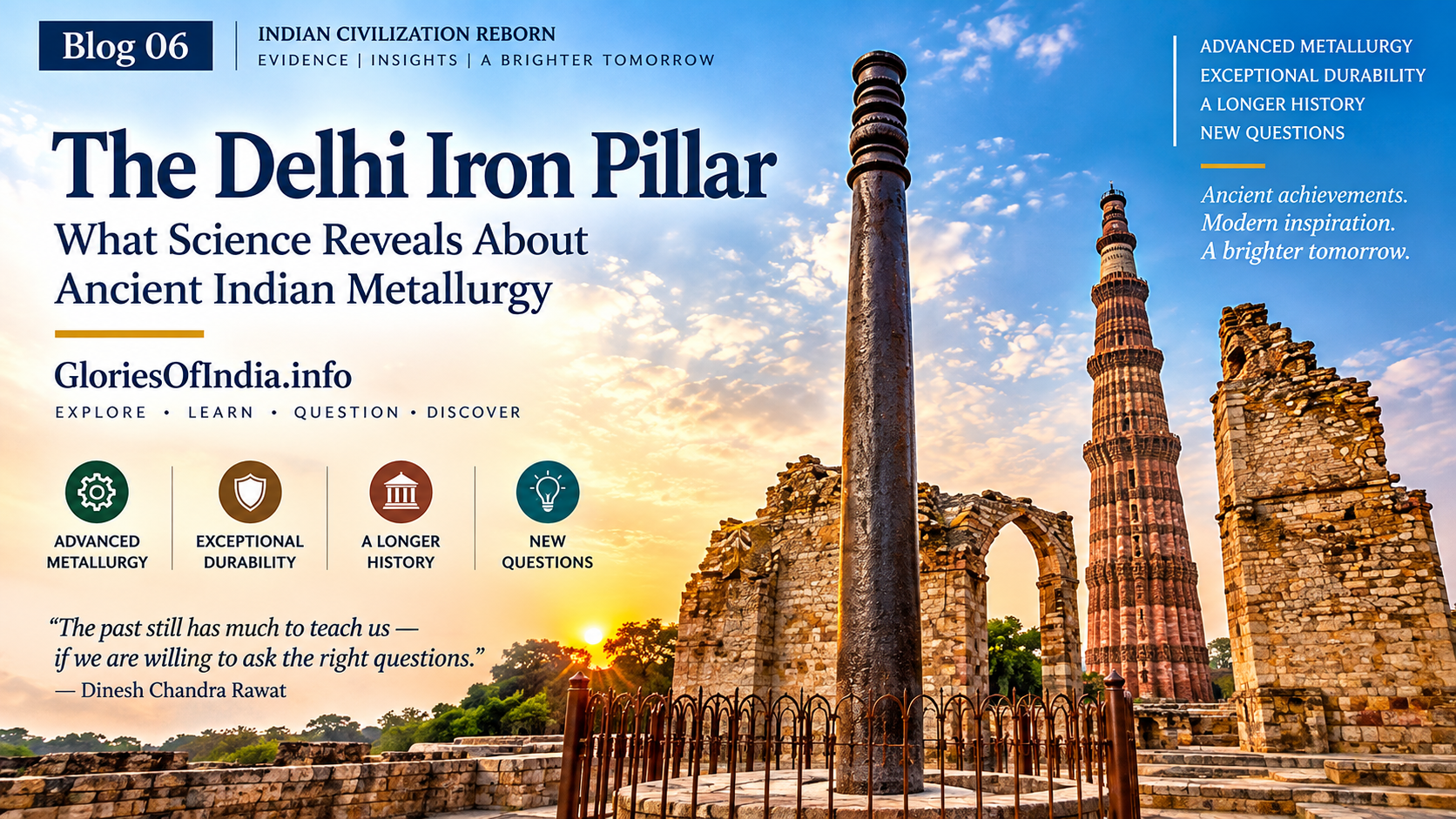
The Delhi Iron Pillar: What Science Reveals About Ancient Indian Metallurgy
The Delhi Iron Pillar is often described as “rustless.” That description is memorable—but scientifically it is not quite correct.
The pillar has corroded. What makes it remarkable is how slowly atmospheric corrosion has progressed over roughly sixteen centuries.
Modern materials science gives us a much more interesting explanation than mystery: ancient iron-making practice, the pillar’s composition and microstructure, a protective surface film, and environmental wetting-and-drying conditions work together.
Why the Iron Pillar Matters
Standing today in the Qutub complex at Mehrauli, the pillar is generally associated with the Gupta period and the reign of Chandragupta II. Metallurgical literature describes it as a roughly 1,600-year-old, forge-welded wrought-iron monument weighing more than six tonnes.
Its importance is therefore twofold.
First, ancient smiths succeeded in manufacturing and joining a very large mass of iron using pre-industrial technology.
Second, the exposed portion has survived with unusually limited atmospheric corrosion.
Neither achievement requires a mythical explanation. Both deserve to be understood technically.
How Was Such a Large Iron Pillar Made?
The pillar was not cast as one enormous piece of molten iron.
Studies describe it as wrought iron produced by ancient solid-state iron-making and assembled through repeated forging and forge-welding of iron masses.
That matters because creating a large, sound structure in this way demands control over heating, hammering, joining and the behaviour of the material.
The resulting iron is not chemically identical to modern structural steel. It contains slag inclusions and has a relatively high phosphorus content, features connected to the production route used by ancient Indian smiths.
It Is Corrosion Resistant, Not Literally Rust-Free
The pillar’s fame has encouraged the popular idea that it “does not rust.” Scientific studies show a more precise picture.
Rust and corrosion products exist on the pillar. The crucial point is that a stable, adherent protective scale has developed at the surface, greatly reducing the subsequent corrosion rate.
Earlier research also noted that different parts of the pillar have experienced different corrosion conditions; the below-ground portion, for example, is not preserved in the same way as the exposed atmospheric surface.
So the scientific question is not, “Why is there no rust?”
The better question is: Why did the corrosion products develop into such an effective protective layer?
What Science Reveals About the Protective Layer
A detailed study published in Corrosion Science characterized the pillar’s rust and identified iron oxides and oxyhydroxides together with a crystalline iron hydrogen phosphate hydrate phase at the metal–rust interface. The research argued that this phosphate-rich layer is a critical factor in the pillar’s superior corrosion resistance. Read the corrosion-science study
This is a form of passivation: the products formed during corrosion themselves help slow further attack.
The protective layer did not appear instantaneously. It developed through long-term interaction between the iron’s composition, its microstructure and the surrounding atmosphere.
Why Phosphorus and Slag Matter
The pillar iron contains considerably more phosphorus than many modern irons. Research by R. Balasubramaniam and others has emphasized that this phosphorus plays an important role in formation of the protective phosphate-bearing film. See the IIT Kanpur research communication
Slag particles embedded in the wrought iron also influence electrochemical reactions at the surface. During early corrosion, these microstructural features can assist phosphorus enrichment near the metal–scale interface, helping the protective layer develop.
This is an excellent example of why ancient material should not be judged only by modern compositional standards.
A feature that might appear to us simply as an “impurity” can participate in the long-term behaviour of the material.
The Role of the Environment
Material composition is not the whole story.
Atmospheric exposure—including repeated wetting and drying—also contributes to the development and maturation of the protective scale. The 2000 corrosion study specifically linked alternate wetting and drying to formation of the crystalline phosphate phase.
Earlier researchers gave greater weight to Delhi’s relatively dry atmospheric conditions; later work emphasized the chemistry and microstructure of the iron and the passive film. The most useful interpretation is therefore not a single-factor slogan but an interaction between material and environment.
What This Tells Us About Ancient Indian Metallurgy
The pillar demonstrates practical mastery at several levels.
Ancient craftspeople had to extract and consolidate iron, repeatedly forge large masses, join them into a monumental object and produce a structure capable of surviving for centuries.
They did not need to possess modern electrochemical theory to achieve this.
Technological knowledge can exist as accumulated practice: observation, material selection, workshop experience, repeated experimentation and transmission of craft skill.
A 2021 Scientific Reports study examining iron produced by traditional Indian methods likewise found strong corrosion resistance associated with microstructural and compositional characteristics, reinforcing the value of studying historical iron-making practice through modern materials science. Read the modern materials study
What the Evidence Does Not Prove
The Iron Pillar should not be turned into evidence for technologies that the material itself does not demonstrate.
Its corrosion resistance does not prove that ancient India possessed modern stainless steel, nanotechnology in the modern engineering sense, or some lost process beyond scientific explanation.
Those claims are unnecessary.
The documented achievement is already substantial: sophisticated large-scale forge welding, distinctive wrought-iron metallurgy and a material/environment interaction that produced exceptional long-term atmospheric corrosion resistance.
Evidence-based admiration is stronger than exaggeration.
Why the Pillar Changes the Question
The most interesting question is not whether the pillar is a “mystery.”
Modern science has explained much of its unusual behaviour.
The deeper question is what this object tells us about the people who made it.
They understood iron through practice. They knew how to work it on a monumental scale. Their craft tradition produced a material whose long-term performance still attracts corrosion scientists and metallurgists.
The Delhi Iron Pillar is not impressive because science cannot explain it. It is impressive because science helps us understand just how much skill went into making it.
Key Takeaways
- The Delhi Iron Pillar is corrosion resistant, not literally rust-free.
- It is a large forge-welded wrought-iron monument dating broadly to the Gupta period.
- Its protective surface scale contains iron oxides/oxyhydroxides and a phosphate-rich phase.
- The relatively high phosphorus content and slag-bearing microstructure of the iron contribute to protective film formation.
- Atmospheric wetting-and-drying conditions also influence development of the protective layer.
- The pillar demonstrates major ancient metallurgical skill without requiring speculative technological claims.
Continue the Research
On GloriesOfIndia.info: Dholavira and the Engineering of Water · Forgotten Knowledge of Ancient India
Companion reflection: What I Learned from Disagreeing with Historians on DineshRawat.live.
Frequently Asked Questions
Is the Delhi Iron Pillar completely rust-free?
No. Corrosion products are present. Its significance lies in the unusually slow atmospheric corrosion of much of the exposed pillar and the stable protective scale that formed on its surface.
Why is the Delhi Iron Pillar so corrosion resistant?
Research points to a combination of its phosphorus-rich wrought iron, slag-bearing microstructure, formation of a protective phosphate-containing passive layer and environmental wetting-and-drying conditions.
What is the pillar made of?
It is made primarily of wrought iron produced and consolidated using ancient iron-making and forge-welding techniques.
Does the pillar prove that ancient India possessed modern stainless-steel technology?
No. Its metallurgy differs from modern stainless steel. Its importance lies in the documented ancient production technique and the exceptional corrosion behaviour of the resulting wrought iron.
From Materials to Civilization
Indian Civilization Reborn examines how archaeology,
technology, environment, texts and scientific evidence can be brought together
to reconstruct a broader picture of India’s civilizational development.
Research References
R. Balasubramaniam — On the Corrosion Resistance of the Delhi Iron Pillar, Corrosion Science (2000)