

Ancient Indian Science and Technology: What the Evidence Reveals
India’s scientific and technological heritage is sometimes presented in two unsatisfactory ways.
One approach gives it only passing attention, leaving readers unaware of important contributions. The other makes sweeping claims about ancient technologies without sufficient historical evidence.
Neither approach does justice to the subject.
The stronger method is to examine specific achievements through dated texts, archaeological remains, scientific analysis and the history of transmission.
Readers interested in this wider process of rediscovery can also explore Forgotten Knowledge of Ancient India, where archaeology and modern scientific methods are brought together to examine India’s intellectual past.
The result is a picture of considerable intellectual and technological accomplishment—one that is more interesting when examined carefully than when exaggerated.
Mathematics: Place Value, Zero and Calculation
The development of positional decimal notation was one of the most consequential achievements in the history of mathematics.
Indian mathematicians made major contributions to the number system that eventually spread through the Islamic world and into Europe.
The history of zero requires particular care. The use of a placeholder and the treatment of zero as a number are related but distinct developments.
Aryabhata, writing in 499 CE, used a sophisticated positional numerical system and developed mathematical methods connected with astronomy. Brahmagupta’s Brahmasphutasiddhanta, composed in 628 CE, gave explicit rules involving zero and negative numbers.
Brahmagupta’s work was not identical to modern mathematics. His treatment of division by zero contained errors. Nevertheless, his effort to formulate arithmetic with zero and negative quantities represents a major documented contribution.
This distinction is important: historical achievement does not require pretending that every ancient proposition was already scientifically complete.
Why the number system mattered
Place-value notation makes calculation efficient because the value of a digit depends upon its position. The combination of positional notation and zero eventually became fundamental to arithmetic, commerce, astronomy and later mathematical development.
The history is one of innovation and transmission across civilizations—not a reason to deny the contributions of other cultures.
Astronomy and Mathematical Modelling
Indian mathematical astronomy developed sophisticated methods for calculating planetary positions, eclipses and other astronomical phenomena.
Aryabhata’s Aryabhatiya contains mathematical and astronomical sections and is a major surviving source for the history of Indian scientific thought.
Readers can explore more about Aryabhata and ancient Indian astronomical thought in our related article on Indian astronomy.
His work included methods for arithmetic, algebraic problems and astronomical calculation. Later scholars, including Brahmagupta, developed and debated earlier approaches.
These texts demonstrate that scientific ideas were not merely preserved as static traditions. They were examined, corrected and extended.
Astronomical knowledge also circulated internationally. Indian mathematical astronomy influenced scholarly traditions beyond the subcontinent, particularly through transmission into the Arabic-speaking world.
Metallurgy: Evidence in Metal and Slag
India’s metallurgical history is supported by both spectacular objects and the less dramatic material remains of production.
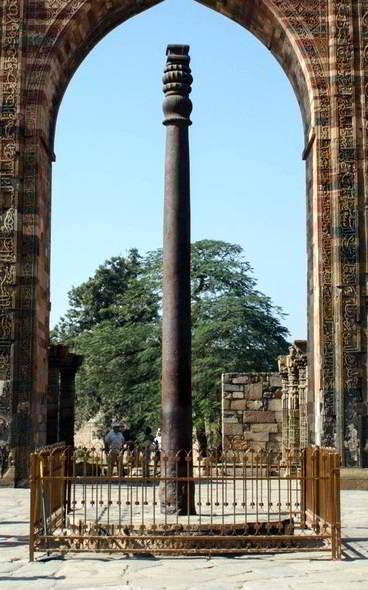
The Delhi Iron Pillar is a well-known example of the durability achievable through historical ironworking. Its corrosion resistance has attracted extensive scientific investigation.
But the history of metallurgy is larger than one monument.
Archaeometallurgists examine furnaces, crucibles, slag, ores, metal artefacts and manufacturing residues. These materials can reveal how metals were smelted, alloyed, forged or cast.
A 2025 review in the Journal of Archaeological Science surveys evidence for Indian copper and bronze production, ironworking, crucible steel and zinc-related technologies. It also emphasises the need for more systematic study of production sites and regional practices.
This provides a useful lesson: ancient technological history advances through scientific examination of actual manufacturing evidence, not merely through claims about the perfection of surviving artefacts.
This same evidence-first approach also appears in our broader discussion of questions that challenge assumptions about history and science.
Harappan Engineering and Water Management
The Harappan Civilization provides material evidence of sophisticated urban and environmental engineering.
Dholavira, in present-day Gujarat, is especially important.
UNESCO describes its planned urban layout, fortifications, reservoirs, drainage systems and management of scarce water resources. The settlement’s inhabitants harnessed seasonal streams and developed systems to collect, divert and store water.
For a broader look at water management and urban planning in ancient India, see our companion article on ancient ecology and city design.
The archaeological site demonstrates that engineering knowledge was applied to the practical challenges of living in an arid environment.
This is a significant achievement in its own right.
It does not require claiming that Harappan engineers possessed every technology available today.
What Dholavira can teach us
The site encourages questions that remain relevant:
How did ancient communities respond to water scarcity?
How were storage and drainage integrated into settlement planning?
What can archaeological evidence reveal about adaptation to changing environmental conditions?
Ancient engineering history is therefore also environmental history.
Medicine and the Sushruta Tradition
The Sushruta Samhita is an important source for the history of Indian medicine and surgery.
It contains descriptions of surgical instruments, procedures, anatomy and medical instruction. Scholarship on the text examines its technological references, historical context and the development of surgical practice.
However, the dating of ancient medical texts is complicated. Surviving works may contain layers of composition, transmission and later revision.
It is therefore better to say that the Sushruta tradition preserves substantial historical surgical knowledge than to assign every passage to one exact ancient year without qualification.
Likewise, traditional medical knowledge should be studied historically and scientifically. Its historical importance does not mean every treatment is automatically validated by modern clinical standards.
Why Evidence Matters More Than Superlatives
Popular discussions frequently ask:
Was India first?
Was this technology more advanced than Europe?
Did ancient scholars already know a modern scientific theory?
These questions can sometimes be legitimate, but they often distract from the more important inquiry.
What exactly did the historical source demonstrate?
How is it dated?
What physical evidence survives?
Can the claim be independently tested?
How did the knowledge develop and spread?
A carefully documented achievement is more valuable than an impressive claim that cannot withstand scrutiny.
This principle also applies to debates involving archaeology, geology and ancient texts, such as the Ghaggar–Hakra and Saraswati question, where multiple kinds of evidence must be considered together.
The Importance of Intellectual Exchange
Scientific history is not a competition in which one civilization must have invented everything.
Mathematical ideas, medical knowledge, astronomical techniques and technological practices travelled through trade, translation, migration and scholarly exchange.
India both contributed to and benefited from these networks.
Recognising this does not diminish Indian achievement. It places it within the wider history of human knowledge.
A Research Agenda for Glories of India
The subject deserves a continuing series rather than one broad overview.
Future articles can examine individual achievements through primary sources and specialist research: the development of zero, Aryabhata’s astronomy, historical metallurgy, Harappan hydraulic engineering, the Sushruta tradition and the scientific study of ancient materials.
Readers can follow this wider programme through Glories of India, where archaeology, civilization, historical interpretation and new research questions are examined across multiple articles.
Each article should distinguish established evidence from interpretation and identify where further research is needed.
Conclusion
Ancient Indian science and technology offer an extensive field of serious historical inquiry.
The evidence supports important achievements in mathematics, astronomy, metallurgy, medicine and engineering.
The appropriate response is neither neglect nor exaggeration.
It is to recover the sources, understand the methods, examine the material evidence and explain the achievements accurately.
India’s scientific heritage is sufficiently significant to stand on documented evidence.