Introduction
Few rivers have influenced a civilization as profoundly as the Saraswati.
The Rigveda, one of humanity’s oldest surviving literary traditions, praises Saraswati more than any other river. It is described not as a seasonal stream or symbolic watercourse, but as a great life-giving river that nourished communities, inspired sages and shaped an entire civilization.
For centuries many historians dismissed these descriptions as mythology because no major river named Saraswati exists today.
Modern science, however, has transformed the discussion.
Satellite imagery, geology, archaeology and hydrology have revealed evidence of extensive ancient river systems beneath northwestern India, reopening one of history’s most fascinating debates.
📜 Voices from Ancient India
Among the most celebrated verses in the Rigveda is the following hymn.
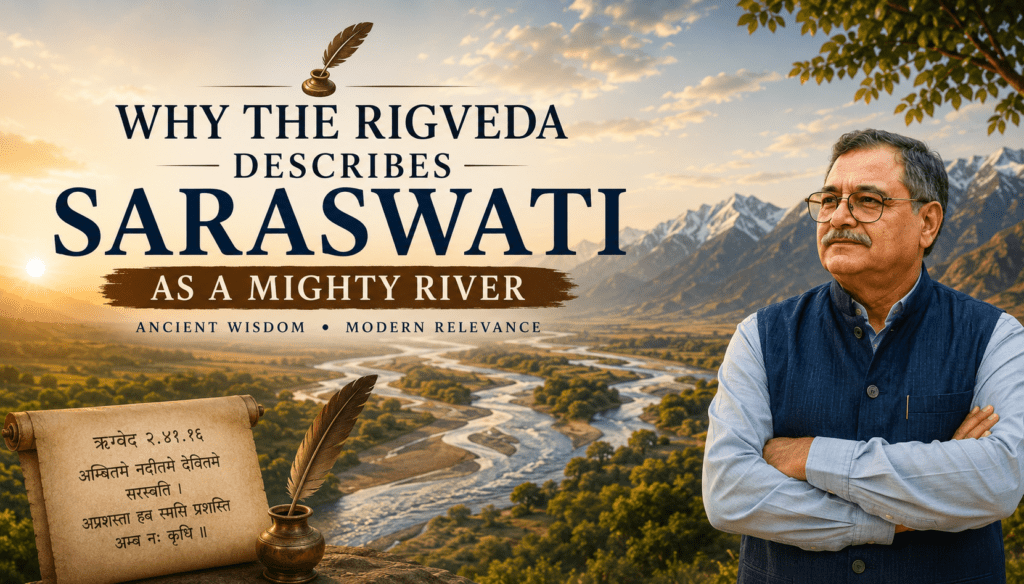
ऋग्वेद २.४१.१६
अम्बितमे नदीतमे देवितमे सरस्वति।
अप्रशस्ता इव स्मसि प्रशस्तिं अम्ब नः कृधि॥
Transliteration
Ambitame Nadītame Devitame Sarasvati,
Apraśastā iva smasi Praśastim Amba Naḥ Kṛdhi.
Translation
“O Saraswati, Best of Mothers, Best of Rivers, Best of Goddesses, grant us honour and prosperity.”
Why This Verse Matters
This is one of the most frequently quoted verses in discussions about the Saraswati River.
The hymn elevates Saraswati above all other rivers known to the Vedic poets, suggesting that she occupied an exceptional place in the landscape and culture of early Vedic society.
Saraswati in the Rigveda
The Rigveda refers to Saraswati in numerous hymns.
She is described as:
- mighty
- nourishing
- life-giving
- ever-flowing
- sacred
- worthy of reverence
Unlike smaller rivers mentioned alongside her, Saraswati occupies a unique position.
She is simultaneously:
- a geographical river,
- a source of prosperity,
- and later, the inspiration for the goddess of wisdom and learning.
This combination of physical and cultural significance makes Saraswati unlike any other river in ancient Indian literature.
📜 Another Remarkable Verse
ऋग्वेद ७.९५.२
एका चेतत् सरस्वती नदीनां शुचिर्यती गिरिभ्यः आसमुद्रात्।
Translation
“Among rivers, Saraswati alone flows in purity from the mountains toward the sea.”
Historical Context
This verse has attracted considerable scholarly attention because it appears to describe a substantial river flowing from mountainous regions toward the sea.
Researchers continue to debate how this description relates to the ancient river systems identified through geology and satellite imagery.
Could Such a River Really Have Existed?
For much of the twentieth century many historians believed the answer was no.
Without visible evidence of such a river, Saraswati was often interpreted as symbolic or mythical.
That assumption began changing dramatically with advances in Earth observation technology.
🛰 Modern Science Enters the Conversation
Today researchers use technologies unimaginable only a few decades ago.
These include:
- Satellite Remote Sensing
- Synthetic Aperture Radar
- Infrared Imaging
- Digital Elevation Models
- Sediment Analysis
- Groundwater Mapping
- Isotope Studies
- Geomorphology
Together these disciplines reveal ancient landscapes hidden beneath deserts and agricultural plains.
One of their most important discoveries has been the identification of extensive palaeochannels beneath northwestern India.
What Is a Palaeochannel?
A palaeochannel is the preserved course of an ancient river that no longer carries water on the surface.
Over thousands of years rivers may:
- shift course,
- dry because of climate change,
- become buried beneath sediments,
- merge with other rivers.
Although invisible today, these ancient channels often remain detectable through satellite imagery and geological investigations.
Archaeology Strengthens the Picture
Scientific discoveries become even more significant when archaeology is added.
Hundreds of ancient settlements are located along these buried river systems.
Among the most important are:
- Bhirrana
- Rakhigarhi
- Kalibangan
- Banawali
- Farmana
- Kunal
- Balu
- Girawad
The remarkable concentration of settlements strongly suggests that dependable water once flowed through this region.
🏺 Rivers Build Civilizations
Throughout history, great civilizations have flourished beside rivers.
Examples include:
Civilization | Major River |
Egypt | Nile |
Mesopotamia | Tigris & Euphrates |
China | Yellow River |
Ancient Bharat | Saraswati and Sindhu River Systems |
Reliable water supports:
- agriculture,
- trade,
- transportation,
- settlements,
- cultural development,
- knowledge systems.
The Rigveda’s reverence for Saraswati reflects precisely this relationship between rivers and civilization.
Different Scholarly Perspectives
The relationship between the Rigvedic Saraswati and the palaeochannels identified by modern science remains an active field of research.
Some scholars argue that geological evidence strongly supports identifying these channels with the Saraswati described in the Rigveda.
Others suggest that the ancient texts preserve memories of several river systems that changed over long periods.
Many researchers agree on one important conclusion:
Northwestern India once supported much larger river systems than those visible today.
The remaining questions concern chronology, hydrology and historical interpretation.
Why This Debate Matters
The discussion is about much more than one river.
It helps us understand:
- the environmental history of ancient India,
- settlement patterns,
- climate change,
- agricultural development,
- cultural continuity,
- the relationship between literature and archaeology.
Most importantly, it demonstrates how ancient texts and modern science can be studied together rather than in isolation.
Timeline
Before 3000 BCE
Large river systems flow across northwestern India.
Third Millennium BCE
Numerous settlements flourish along these river corridors.
Vedic Period
Rigvedic hymns celebrate Saraswati as a mighty river.
Historical Period
River systems gradually change because of climatic and geological processes.
20th Century
Geologists begin identifying ancient river courses.
21st Century
Satellite imagery and remote sensing reveal extensive buried palaeochannels.
Key Takeaways
✔ The Rigveda consistently describes Saraswati as one of the greatest rivers known to its composers.
✔ Sanskrit verses portray Saraswati as both a mighty river and a cultural symbol.
✔ Modern satellite imagery has identified extensive buried river systems beneath northwestern India.
✔ Archaeological sites are concentrated along these ancient waterways.
✔ The relationship between literary descriptions and geological evidence remains an active and fascinating field of interdisciplinary research.
Frequently Asked Questions
How many times is Saraswati mentioned in the Rigveda?
Saraswati appears in numerous hymns and is among the most frequently mentioned rivers in the Rigveda.
What does “Ambitame Naditame Devitame” mean?
It is commonly translated as “Best of Mothers, Best of Rivers, Best of Goddesses.”
What is a palaeochannel?
A palaeochannel is the preserved course of an ancient river that no longer flows on the surface.
Can satellites detect ancient rivers?
Yes. Modern remote sensing technologies can identify buried river channels, floodplains and geological formations invisible from the ground.
Has the Saraswati debate been settled?
No. While scientific discoveries have greatly advanced understanding, researchers continue to examine chronology, hydrology and the relationship between ancient texts and geological evidence.
Continue Exploring
- Was the Saraswati River Real?
- Latest Satellite Evidence of the Saraswati River
- Saraswati vs Indus Civilization
- Bhirrana: One of the World’s Oldest Settlements
- Rakhigarhi DNA Explained
- The Ghaggar-Hakra Debate
- Ancient Rivers That Built Civilizations
- Indian Civilization Reborn
📚 Featured Book
Indian Civilization Reborn
This article forms part of the ongoing Indian Civilization Reborn Research Project, which examines India’s civilizational continuity through archaeology, astronomy, geology, genetics, ancient literature and environmental history.
The forthcoming book presents detailed maps, timelines, photographs, illustrations and interdisciplinary research collected over more than 35 years.
Coming Soon
Author: Dinesh Chandra Rawat
Publisher: Glories of India Publications
A Journey from Commercial Success to a Life Dedicated to Nature
There comes a moment in many lives when success is no longer measured by wealth, expansion or recognition, but by purpose. For me, that moment arrived after years of building businesses, travelling across the world and achieving what many would consider professional success.
Instead of asking, “How can I grow my business?”, I began asking a very different question:
“How can I contribute something meaningful to the world?”
That single question changed the direction of my life.
A Life Built Through Business
My professional journey began in the world of business.
Over several decades, I had the privilege of working with people from different countries, building enterprises, managing international trade and learning how organisations grow. Business gave me experience, confidence and opportunities to travel extensively.
I visited more than sixty countries, interacted with people from diverse cultures and observed how nations developed, protected their heritage and cared for their environment.
Those journeys taught me something that no classroom ever could.
The More I Travelled, the More I Valued Nature
Every country has its own identity.
Some were known for their history.
Some for their architecture.
Some for technology.
But the places that remained closest to my heart were those where people lived in harmony with nature.
Ancient forests.
Beautiful botanical gardens.
Protected wetlands.
Public parks filled with families.
Communities that respected rivers, trees and wildlife.
These experiences gradually transformed my thinking.
Success Began to Feel Different
Business expansion had always been exciting.
New projects.
New markets.
New opportunities.
Yet, with every passing year, I realised that financial growth alone could never become life’s final destination.
I began asking deeper questions.
What kind of legacy would I leave behind?
Would people remember the companies I built, or the positive difference I made?
Could business become a means to serve society instead of being an end in itself?
Those questions stayed with me.
Green Mall Was Never Just a Nursery
Many people know Green Mall as a destination for plants and landscaping.
To me, it has always represented something much larger.
It is a place where people reconnect with nature.
Where children discover the joy of growing plants.
Where families learn that every tree planted today becomes a gift to future generations.
Green Mall became my classroom.
Every visitor reminded me that environmental awareness begins with simple conversations and practical experiences.
Choosing Purpose Over Expansion
There came a point when I consciously decided not to pursue endless commercial expansion.
Instead, I chose to invest my time, energy and resources into work that could create lasting value.
That decision led to initiatives focused on:
- Environmental education
- Tree plantation
- Biodiversity conservation
- Sustainable gardening
- Nature awareness
- Research and publishing
- Community participation
The satisfaction I found in these activities was unlike anything business success alone could provide.
Nature Became My Greatest Teacher
Working closely with plants taught me patience.
Forests taught me resilience.
Rivers taught me continuity.
Seeds taught me hope.
Every season became a lesson in renewal.
Nature never wastes.
Nature never hurries.
Nature creates balance.
The more I observed these principles, the more I realised that they apply equally to human life.
From Entrepreneur to Environmentalist
People sometimes ask whether I regret slowing down my business ambitions.
My answer is simple.
Not for a single day.
Business gave me the resources to build.
Nature gave me the reason to build.
Today, I consider myself fortunate that life allowed me to experience both worlds.
One taught me how to create enterprises.
The other taught me how to create purpose.
My environmental journey naturally evolved into the creation of Prakriti Bandhu Trust.
The vision was straightforward:
To inspire individuals and communities to live more responsibly towards nature.
Through education, tree plantation, environmental awareness and practical action, the Trust seeks to encourage a culture where conservation becomes part of everyday life rather than an occasional activity.
Writing Became Another Form of Service
As my understanding deepened, I felt the need to document my experiences.
Books became another way of sharing ideas.
Some explore Indian civilization.
Others focus on gardening, environmental conservation and sustainable living.
Each book reflects a common belief:
Knowledge has value only when it inspires positive action.
A Message to Young Entrepreneurs
Success is important.
Innovation is important.
Economic growth is important.
But none of these should come at the cost of the environment that supports all life.
My advice to young entrepreneurs is simple:
Build successful businesses.
Create employment.
Pursue excellence.
But never forget your responsibility towards nature.
A truly successful enterprise improves not only profits but also people and the planet.
Looking Ahead
My journey continues.
There are still many books to write.
Many trees to plant.
Many people to inspire.
Many questions to explore.
If my work encourages even one person to plant a tree, protect a river, create a garden or appreciate the beauty of nature, then I believe my decision to choose purpose over expansion has been worthwhile.
Key Takeaways
- Success is most meaningful when guided by purpose.
- Business can become a powerful force for environmental good.
- Nature teaches patience, balance and sustainability.
- Environmental education begins with everyday experiences.
- Every individual has the ability to leave a positive legacy.
Related Articles
Featured Projects
- Green Mall – Promoting sustainable gardening and landscaping.
- Prakriti Bandhu Trust – Environmental education and conservation.
- Ma Prakriti Mandir – Celebrating humanity’s connection with nature.
- Green Guru Knowledge Series – Books that inspire greener living.
About the Author
Dinesh Chandra Rawat is an author, environmentalist, entrepreneur and independent researcher. After decades in international business, he chose to dedicate his life to environmental conservation, nature education and publishing. Through Green Mall, Prakriti Bandhu Trust and his books, he continues to encourage people to reconnect with nature, preserve India’s environmental heritage and build a more sustainable future.